Advertisements

Bug Bounty Hunting: Ethical Hacking & Web Pentesting Guide

Advertisements
Master Web Application Security, Reconnaissance, Vulnerability Discovery, Exploitation, API Testing, Bug Bounty Hunting
5
5/5
(1) Ratings
20 students
Created by Vivek Kumar Pandit | OSCP+
Advertisements

What you'll learn

  • Learn a structured methodology for web application penetration testing.
  • Perform information gathering, reconnaissance, and attack-surface discovery.
  • Identify and test vulnerabilities such as XSS, SQL Injection, and Command Injection.
  • Test authentication, session management, and access control vulnerabilities.
  • Discover vulnerabilities such as SSRF, CSRF, SSTI, XXE, and file inclusion.
  • Identify business logic flaws, race conditions, cache poisoning, and insecure deserialization.
  • Perform API and LLM security testing using practical techniques and tools.
  • Document vulnerabilities and create professional penetration testing reports.
This course includes:
14.5 total hours on-demand video
1 articles
9 downloadable resources
148 lessons
Full lifetime access
Access on mobile and TV
Certificate of completion
Advertisements

Course content

Requirements

  • Basic understanding of computers, operating systems, and networking.
  • Basic knowledge of HTTP and HTTPS is recommended.
  • Familiarity with web browsers and how websites work.
  • Basic Linux command-line knowledge is helpful but not mandatory.
  • No prior professional penetration testing experience is required.
  • A computer capable of running the required virtual machines and security tools.
  • Basic programming or scripting knowledge is helpful but not mandatory.
  • Students should be willing to practice using authorized labs and vulnerable applications.

Description

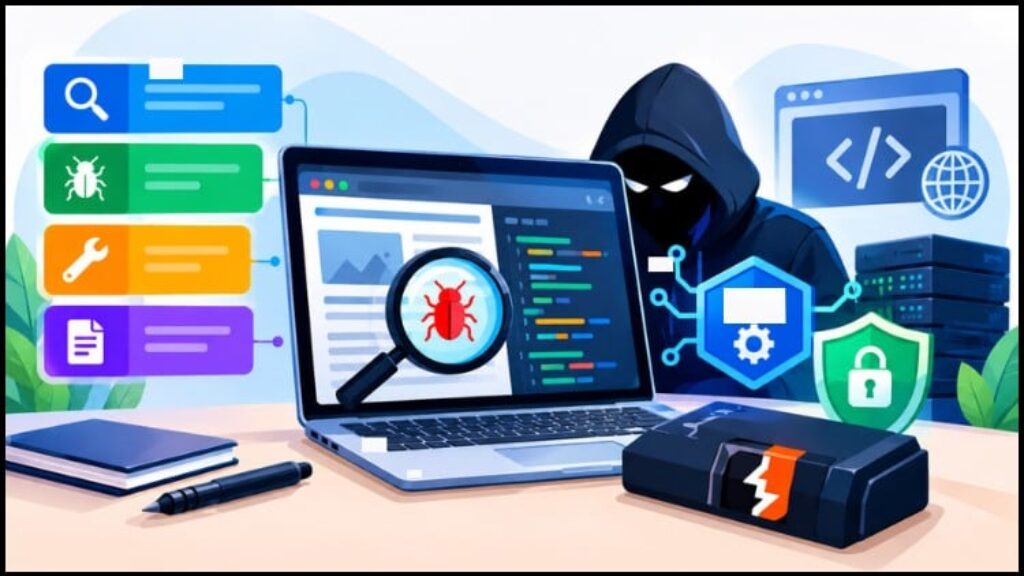
Bug Bounty Hunting: Ethical Hacking & Web Pentesting Guide is a practical course designed to help you understand how web applications and APIs are tested from an ethical hacking and penetration testing perspective. The course covers the complete process from information gathering and reconnaissance to vulnerability discovery, exploitation, vulnerability chaining, and professional report writing. You will learn how to use tools such as Burp Suite and apply a structured methodology while testing web applications in practical lab environments.

Throughout the course, you will learn and practice a wide range of web application vulnerabilities, including Cross-Site Scripting (XSS), SQL Injection, Command Injection, Path Traversal/Directory Traversal, Local File Inclusion (LFI), Remote File Inclusion (RFI), File Upload Vulnerabilities, Sensitive Data Exposure, Authentication and Session Management vulnerabilities, Access Control vulnerabilities, Cross-Site Request Forgery (CSRF), Open Redirect, Server-Side Request Forgery (SSRF), Host Header Attacks, Server-Side Template Injection (SSTI), XML External Entity (XXE) Injection, Business Logic vulnerabilities, Web Cache Poisoning, Insecure Deserialization, Race Conditions, API security vulnerabilities, JWT-related security issues, and LLM Security. The course also introduces vulnerability chaining and explains how multiple weaknesses can interact within a real-world application.

What You Will Learn

  • Web Application Penetration Testing & VAPT Methodology

  • Bug Bounty Hunting Methodology

  • Information Gathering & Reconnaissance

  • Burp Suite for Web Security Testing

  • Cross-Site Scripting (XSS)

  • SQL Injection

  • Command Injection

  • Path Traversal / Directory Traversal

  • LFI & RFI

  • File Upload Vulnerabilities

  • Sensitive Data Exposure

  • Authentication & Session Management

  • Access Control Vulnerabilities

  • CSRF

  • Open Redirect

  • SSRF

  • Host Header Attacks

  • SSTI

  • XXE Injection

  • Business Logic Bugs

  • Web Cache Poisoning

  • Insecure Deserialization

  • Race Conditions

  • API Pentesting

  • JWT Security Testing

  • LLM Security

  • Vulnerability Chaining

  • Exploitation Techniques

  • Professional Vulnerability Report Writing

Whether you’re a beginner in ethical hacking, aspiring bug bounty hunter, cybersecurity student, or penetration tester, this course will help you develop a practical approach to discovering and understanding vulnerabilities in modern web applications and APIs.

Who this course is for:

  • Beginners who want to start learning web application penetration testing.
  • Aspiring bug bounty hunters who want to find web security vulnerabilities.
  • Cybersecurity students looking for practical web security skills.
  • Ethical hackers who want to improve their vulnerability assessment techniques.
  • Penetration testers who want to strengthen their web application testing methodology.
  • Security professionals preparing for practical penetration testing certifications.
  • Developers who want to understand common web application vulnerabilities.
  • Anyone interested in learning web security through practical, hands-on testing.
Advertisements
71FB113A499B02DA1753
Advertisements
Advertisements
Free Online Courses with Certificates
Logo
Register New Account