Advertisements

Enterprise AI Architecture: Hands-On Integration Design

Advertisements
Design secure AI solutions with RAG, fine-tuning, agents, enterprise APIs, observability, and governance.
1
1/5
(42) Ratings
150 students
Created by School of AI
Advertisements

What you'll learn

  • Design scalable, secure, and reliable enterprise AI architectures that integrate with existing business systems.
  • Evaluate RAG, fine-tuning, agentic AI, and hybrid architectures to select the right approach for enterprise use cases.
  • Build hands-on AI solutions using Python, FastAPI, Ollama, vector databases, and enterprise APIs.
  • Design and implement Retrieval-Augmented Generation (RAG) pipelines for enterprise knowledge and document retrieval.
  • Integrate large language models with enterprise databases, REST APIs, CRM systems, and business workflows.
  • Architect AI agents with tool calling, workflow orchestration, state management, and human-in-the-loop approvals.
  • Apply enterprise AI security best practices, including authentication, authorization, PII protection, and data residency controls.
  • Implement AI guardrails, audit logging, responsible AI policies, and governance frameworks.
  • Evaluate AI applications using automated testing, retrieval metrics, output quality assessments, and feedback loops.
  • Build observability and monitoring solutions for AI performance, latency, reliability, and operational costs.
  • Create professional AI architecture diagrams, decision matrices, and technical design documentation.
  • Deliver an end-to-end enterprise AI integration solution through a practical capstone project.
This course includes:
9 total hours on-demand video
18 articles
1 downloadable resources
108 lessons
Full lifetime access
Access on mobile and TV
Certificate of completion
Advertisements

Course content

Requirements

  • No prior AI architecture or machine learning experience is required. The course introduces foundational concepts before moving into advanced topics.
  • Basic understanding of software applications, APIs, databases, or enterprise IT systems is helpful but not mandatory.
  • Familiarity with Python programming is recommended for completing the hands-on coding exercises.
  • A Windows, macOS, or Linux computer with internet access for downloading course tools and resources.
  • Willingness to install free development tools such as Python, Visual Studio Code, Ollama, and Docker.
  • A computer with sufficient memory to run a small local language model is recommended. Some exercises may require additional resources.
  • No paid cloud subscriptions, commercial AI APIs, or enterprise software licenses are required for the core labs.
  • Interest in designing practical AI solutions that address real-world enterprise integration, security, and governance challenges.

Description

This course contains the use of artificial intelligence.

Learn how to design, integrate, secure, and govern enterprise AI solutions through practical architecture patterns, hands-on labs, and real-world business scenarios.

Building an AI chatbot is relatively easy. Designing an AI solution that integrates with enterprise applications, protects sensitive data, handles failures, meets compliance requirements, and operates reliably at scale? That’s where enterprise AI architecture becomes essential.

Welcome to Enterprise AI Architecture: Hands-On Integration Design, a practical course that takes you beyond AI prototypes and teaches you how to architect real-world enterprise AI systems.

Whether you’re a solution architect, enterprise architect, software engineer, AI engineer, or technology professional, this course will help you understand the architectural decisions behind successful enterprise AI implementations.

What You’ll Learn

You’ll explore the essential building blocks of modern enterprise AI architecture, including:

  • AI Architecture Patterns: Understand RAG, fine-tuning, agentic AI, and hybrid approaches. Learn when to use each pattern and evaluate tradeoffs involving performance, accuracy, cost, and complexity.

  • Enterprise AI Integration: Connect language models with enterprise databases, REST APIs, CRM systems, document repositories, and existing business applications.

  • Retrieval-Augmented Generation (RAG): Design knowledge retrieval pipelines using embeddings, vector databases, document processing, and retrieval optimization.

  • Agentic AI Architecture: Build AI agents with tool calling, workflow orchestration, state management, and human approval mechanisms.

  • Security and Privacy: Design authentication, authorization, PII protection, data residency controls, secure API integrations, and safeguards against prompt injection.

  • AI Governance and Responsible AI: Implement guardrails, audit logging, policy enforcement, risk management, and human oversight.

  • Observability and Evaluation: Monitor AI applications, evaluate model outputs, measure retrieval quality, track performance, and establish continuous improvement processes.

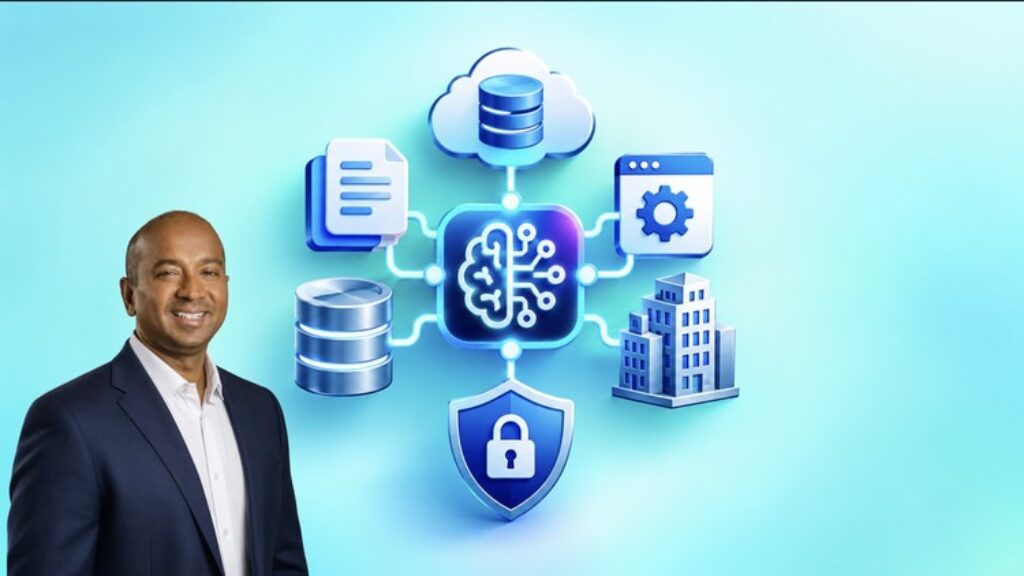
  • Production Architecture: Understand scalability, reliability, fault tolerance, deployment strategies, model gateways, and cost optimization.

Learn by Building a Real Enterprise AI Solution

Throughout the course, you’ll work on BrightDesk Enterprise AI Hub, a fictional enterprise platform that brings together AI models, internal knowledge, customer information, and business workflows.

Instead of completing disconnected exercises, you’ll progressively design and build an integrated AI solution.

You’ll create architecture diagrams, implement APIs, build RAG pipelines, integrate enterprise services, design AI agents, enforce security controls, and establish monitoring and governance practices.

Using technologies such as Python, FastAPI, Ollama, LangChain, vector databases, and Docker, you’ll gain practical experience with tools commonly used in modern AI engineering.

The core exercises use free, local-first tools, so paid AI subscriptions aren’t required.

Who Should Enroll?

This course is designed for enterprise architects, solution architects, AI engineers, software developers, integration specialists, forward deployed engineers, technical leads, and professionals interested in enterprise AI system design.

No previous AI architecture experience is required. We’ll start with foundational concepts and progressively introduce more advanced architecture and integration techniques.

Your Final Project

You’ll bring everything together by designing and demonstrating an enterprise AI solution, complete with integration workflows, security controls, architecture documentation, evaluation results, and production-readiness considerations.

By the end of this course, you’ll understand not just how to build AI applications, but how to architect AI systems that businesses can integrate, manage, secure, and scale.

Move beyond AI demos. Start designing enterprise AI solutions that solve real business problems.

Who this course is for:

  • Enterprise Architects who want to incorporate generative AI into enterprise architecture strategies, standards, and technology roadmaps.
  • Solution Architects responsible for designing scalable AI integrations across enterprise applications, databases, APIs, and platforms.
  • AI Architects and AI Engineers looking to strengthen their knowledge of RAG, fine-tuning, agentic AI, integration patterns, security, and governance.
  • Software Developers and Backend Engineers who want to progress from building AI prototypes to architecting enterprise-ready AI applications.
  • Integration Architects and Engineers working with enterprise APIs, microservices, legacy systems, CRM platforms, and business workflows.
  • Forward Deployed Engineers (FDEs) who need to design, implement, and deliver AI solutions that solve real customer business problems.
  • Technical Leads and Engineering Managers responsible for AI architecture decisions, technical standards, solution delivery, and production readiness.
  • DevOps, MLOps, and AI Platform Engineers interested in AI deployment architectures, observability, evaluation, reliability, and operational governance.
  • Cybersecurity and AI Governance Professionals who want to understand enterprise AI risks, privacy controls, guardrails, compliance, and responsible AI practices.
  • IT Consultants and Technology Professionals who advise organizations on AI adoption, architecture modernization, and enterprise AI integration.
  • Students and Career Changers interested in building practical skills for enterprise AI architecture, solution design, and AI engineering roles.
  • Business and Technology Decision-Makers who want to understand AI architecture tradeoffs and evaluate enterprise AI solutions without needing to become machine learning specialists.
Advertisements
NOVFREE02
Advertisements
Advertisements
Free Online Courses with Certificates
Logo
Register New Account