Test How Well You Really Know Data Structures and Algorithms
Most interview mistakes are not about forgetting an algorithm. They come from details: a binary search that never stops, a sliding window whose left edge moves backwards, a heap that is not sorted, a memo key that forgets a parameter, a Dijkstra that trusts a negative edge, or a slice that quietly turns a linear loop into a quadratic one. These practice tests check whether you can spot those details before they cost you an interview or a production incident.
What this practice test course offers:
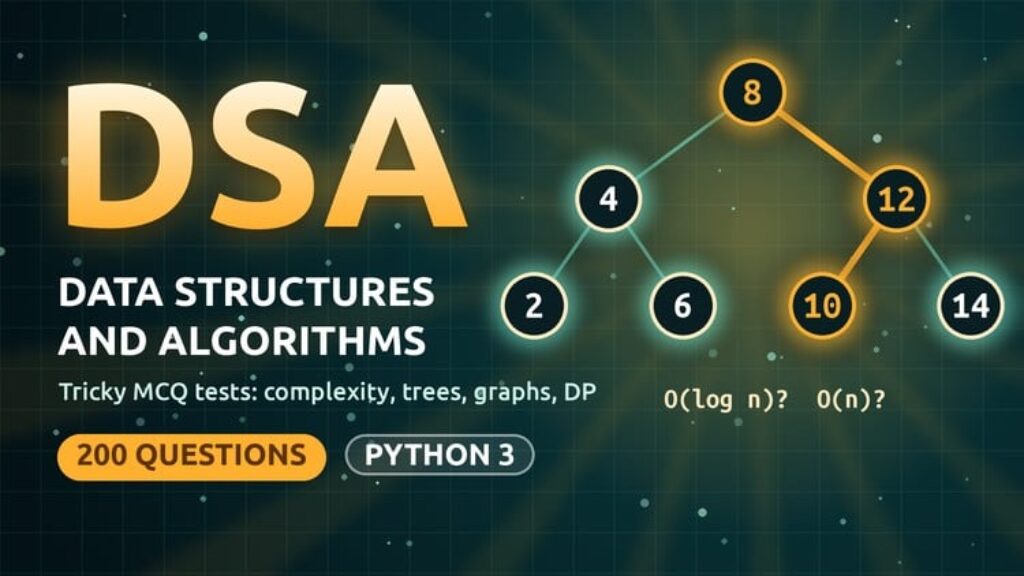
- 200 original multiple-choice questions in 4 practice tests of 50, grouped by topic
- Short Python 3 programs you must trace: what do they print, which exception do they raise, or do they ever finish
- Complexity questions that include the hidden costs of built-in operations such as slicing, in on a list, string concatenation and popping from the front of a list
- An explanation for every answer option, plus an overall explanation of the rule behind it
- Every program was run with Python 3, so every keyed answer matches what the interpreter really does
Topics covered:
- Big O, Omega and Theta, recurrences, amortized versus average cost, and the real cost of Python built-ins
- Binary search boundaries, bisect, binary search on the answer, two pointers, sliding windows and prefix sums
- Stacks, queues, deques, ring buffers, monotonic stacks and heaps with heapq
- Hash tables, hashability, collisions, linear probing, linked lists, cycle detection and LRU caches
- Trees, BST insertion, deletion and validation, AVL and red-black guarantees, tries, B-trees and Fenwick trees
- BFS, DFS, Dijkstra, Bellman-Ford, topological sort, union-find, minimum spanning trees and Floyd-Warshall
- Recursion, memoization, dynamic programming, backtracking and generators
- Sorting stability and lower bounds, quicksort and merge sort details, greedy algorithms and bit manipulation
Who should take this course?
- Developers preparing for coding interviews, online assessments or a data structures exam
- Python programmers who want to know what their code really costs
- Computer science students who have finished a DSA course and want challenging practice questions
You should already know basic Python syntax and the classic data structures. If you have never met a binary tree or a hash table, start with a data structures course and come back here to test yourself.
How to use the tests: take one test at a time, then read every explanation, including the ones for questions you answered correctly. Retake a test a few days later to check that the rules have stuck.
This course is independent and is not affiliated with or endorsed by the Python Software Foundation. Python is a registered trademark of the Python Software Foundation.