AI agents can now read a codebase, plan a change, write the code, run the tests, fix their own mistakes and open a pull request, sometimes in minutes. Every software team is now asking the same question: how do we use agentic AI to build software faster without losing control of quality, security or our own understanding of the system?
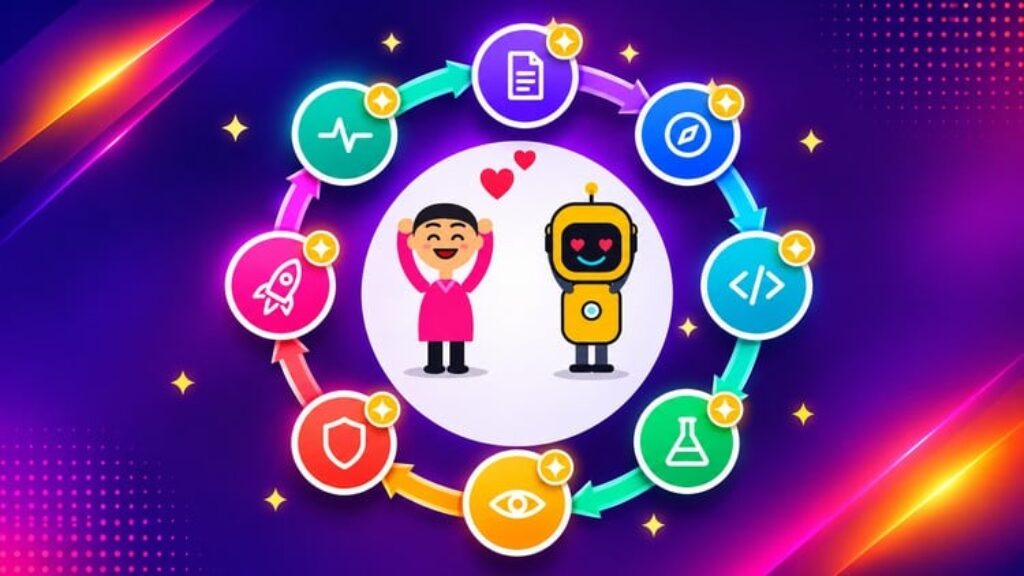
This course answers that question, phase by phase, across the entire Software Development Life Cycle (SDLC).
Complete Agentic SDLC Course: Build Software with AI Agents is a practical, honest guide to building software when AI agents are part of the team. It covers requirements, architecture, coding, testing, code review, security, CI/CD, operations, governance and team adoption. This is not a “10 clever prompts” course. You will learn the process, guardrails and engineering habits that real teams use to make AI agents productive and safe. These are the skills companies now expect from AI engineers, senior developers and tech leads.
The whole course follows one real product, TicketNest, a movie-ticket booking app. You will watch AI agents plan its features, write its code, test it, attack it, ship it and keep it running in production, so every idea lands on something concrete.
The course has 12 modules, 77 lectures and 8+ hours of animated, beginner-friendly video, plus ready-to-use project files, lecture notes, quizzes, flashcards and cheat sheets.
What you will learn
Module 1: From SDLC to Agentic SDLC
-
The classic SDLC in one look
-
The three waves of AI in software: autocomplete, chat and agents
-
What makes software “agentic”
-
The autonomy ladder
-
What the Agentic SDLC is
-
Traditional vs Agentic SDLC, phase by phase
-
AI hype vs reality
Module 2: Anatomy of an AI Agent
-
How an LLM (large language model) works
-
Context, randomness and reasoning
-
The agent loop and tool calling
-
Context engineering: why most agent failures are context failures
-
Memory and rules files
-
MCP (Model Context Protocol): plugging agents into your tools
-
A2A: agents talking to agents
-
Skills, commands and hooks
-
Multi-agent patterns
-
Where agents run: IDE, terminal, cloud and CI
Module 3: Requirements and Planning with Agents
-
Why requirements matter more in the age of AI
-
AI agents as business analysts
-
Spec-driven development
-
Writing specs agents can actually execute
-
Task decomposition for agents
-
Planning, estimation and risk with AI
Module 4: Architecture and Design with Agents
-
The agent as a design partner
-
Design docs and Architecture Decision Records (ADRs)
-
Diagrams as code
-
Agent-friendly codebases
-
Architectural guardrails agents cannot quietly break
Module 5: Agentic Development (AI Coding)
-
Five ways to code with AI
-
The Explore, Plan, Code, Verify workflow
-
Scoping work for an AI agent
-
Running parallel agents
-
Vibe coding vs agentic engineering
-
AI agents on brownfield and legacy code
-
Comprehension debt: the hidden cost of AI-generated code
Module 6: Testing and QA with Agents
-
Tests as the trust layer
-
Agent-written unit and integration tests
-
TDD with AI agents
-
Testing the tests: mutation testing and beyond
-
E2E and UI testing with browser agents
-
Test data, flaky tests and triage
Module 7: Code Review and Quality
-
The new bottleneck: code review
-
AI code reviewers
-
Layered review
-
Pull requests a reviewer can trust
-
Detecting and stopping quality drift
Module 8: Security in the Agentic SDLC
-
The two sides of agent security
-
AI agents that find and fix vulnerabilities
-
Prompt injection and goal hijacking
-
Tool misuse and excessive agency
-
The agentic supply chain
-
Secrets and data leakage
-
The OWASP Top 10 for agentic applications (two parts)
Module 9: CI/CD, Deployment and Release
-
AI agents inside the CI/CD pipeline
-
Self-healing builds
-
Infrastructure as Code with agents
-
Safe releases: feature flags and canary rollouts
-
Automated release notes and docs
Module 10: Operations, Incidents and Maintenance
-
SRE agents and alert triage
-
Incident response with AI agents
-
Observing the agents themselves
-
Migrations and modernization
-
Living documentation
-
Continuous maintenance and AI automation
Module 11: Governance, Evaluation and Impact
-
Measuring the real impact of AI (DORA, SPACE and more)
-
Evaluating AI agents
-
Cost and ROI of AI agents
-
Designing human-in-the-loop checkpoints
-
Accountability and compliance
-
Governing AI agents at scale
Module 12: People, Roles, Adoption and the Future
-
How every role changes: developer, tester, architect, PM and lead
-
The new AI engineering skill stack
-
How junior developers can still learn
-
A step-by-step adoption roadmap for your team
-
Anti-patterns and real failure stories
-
What comes next for agentic AI
Every lecture follows the same proven structure
Each lecture starts with a real problem. It then explains the idea in simple language with animations and an everyday analogy, and shows how it works step by step with diagrams. After that come the honest trade-offs, a practical “what to set up today” section, a one-minute recap and a real interview question with a strong answer.
Bonus resources you can use in your own projects
-
Ready-to-use artifact kits for every module. These are real project files you can copy straight into your repository: rules files, agent hooks, spec templates, ADRs, architecture checks, test setups, PR templates, AI code-review workflows, security scanners, CI/CD pipelines, runbooks, evaluation scripts and governance policies. Each kit comes with step-by-step instructions.
-
Lecture notes for all 77 lectures, in a clean handwritten style that is easy to revise from.
-
A review pack:
-
a 5-question quiz after every module, with every answer explained
-
340 flashcards, as an Anki deck and as printable cards
-
a one-page cheat sheet for every module
-
Who this course is for
-
Software developers who already use an AI coding assistant and want to get far more out of AI agents
-
Aspiring AI engineers who want to understand how agentic AI is used in real software delivery
-
Testers and QA engineers moving into AI-assisted testing and automation
-
Tech leads, architects and engineering managers bringing AI agents into a team safely
-
DevOps, platform and SRE engineers exploring AI automation in CI/CD and operations
-
Product managers and business analysts who want to write specs that AI agents can execute
-
Students and career switchers who want a future-proof skill in AI-driven software development
Prerequisites
You do not need any background in AI, machine learning or prompt engineering. If you understand the basics of how software is built, you are ready. Everything else is explained from scratch in simple language.
Why this course?
Everyone has access to the same AI tools. The teams that win with AI agents are the ones that change their process: clear specs before code, tests they can trust, review that is not a rubber stamp, guardrails on what an agent can touch, and humans who stay in charge of the decisions that matter. That process is the Agentic SDLC, and it is one of the most valuable skills in software engineering right now.
By the end of this course you will stop seeing AI agents as magic or as a threat. You will see them as powerful teammates that need a good process around them, and you will know how to build that process.
About your instructor
Hi! My name is Yogesh Dahake. I am a Lead Software Engineer with over a decade of experience designing, architecting and delivering enterprise software in multinational product companies. I have taught over a thousand people about software development through my courses and YouTube channel. My goal is to make learning simple, practical and free of clutter, and to help you build skills that last.
30-day full money-back guarantee
This course comes with Udemy’s 30-day money-back guarantee. Take the course, watch the lectures and use the resources. If you are not happy for any reason, you can request a full refund within 30 days of enrolment.
So, what are you waiting for? Enroll now, learn to build software with AI agents the way the best engineering teams do, and become the engineer your team turns to when it is time to work with AI.