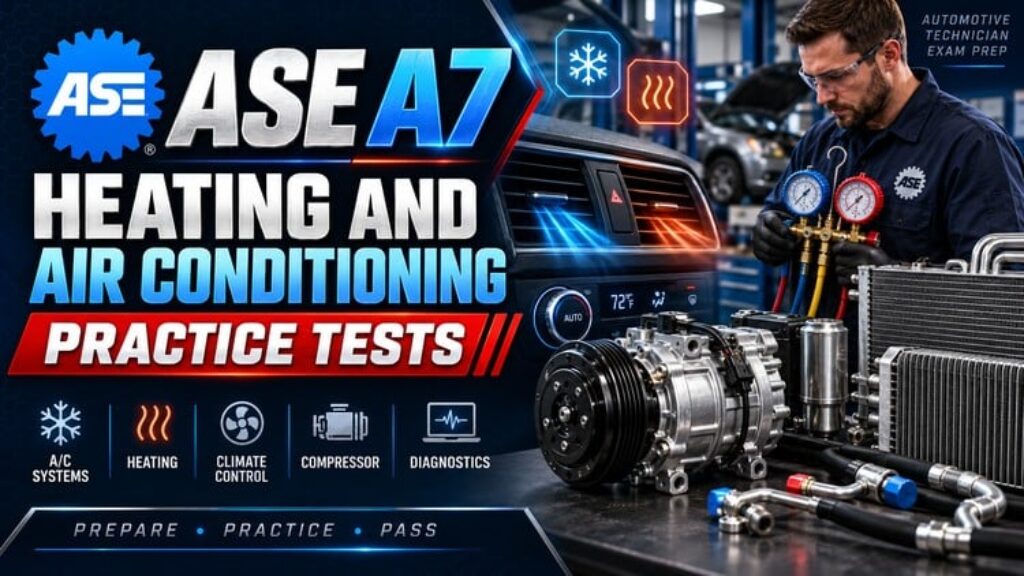
Preparing for the ASE A7 exam takes more than memorizing HVAC terms. You need to understand how refrigerant pressures, temperatures, airflow, electrical controls, cooling-system conditions, and component failures work together during real vehicle diagnosis.
This practice-based course is designed to help you develop that understanding.
You’ll work through realistic questions covering automotive heating and air conditioning systems—from basic refrigeration principles and A/C performance testing to compressors, condensers, evaporators, engine cooling systems, blower controls, automatic climate control, and modern hybrid/EV HVAC technology.
The course gradually moves from core concepts into more diagnostic and scenario-based questions, giving you an opportunity to recognize weak areas and improve the way you approach HVAC problems.
ASE A7 Exam at a Glance
The current ASE A7 Heating and Air Conditioning certification test contains 60 total questions, of which 50 are scored, with 75 minutes allowed for the exam. ASE notes that the additional 10 questions are research questions and candidates are not told which questions are unscored.
The scored subject emphasis is:
-
42% — HVAC and Engine Cooling System Service, Diagnosis, and Repair
-
20% — Refrigeration System Component Diagnosis and Repair
-
38% — Operating Systems and Related Controls Diagnosis and Repair
That means roughly 4 out of every 5 scored questions relate either to general HVAC/engine cooling diagnosis or HVAC operating systems and controls. This course gives those areas the depth they deserve.
Why This Practice Course?
Automotive HVAC diagnosis is rarely about one isolated component.
A customer may complain that the A/C is not cold enough, but the actual cause could involve refrigerant charge, condenser airflow, compressor performance, an expansion device, an electrical control input, a blend door, or even engine cooling-system operation.
That is why this course emphasizes diagnostic thinking rather than simple memorization.
You will practice interpreting:
-
High-side and low-side A/C pressure readings
-
Vent and component temperatures
-
Refrigerant flow symptoms
-
Compressor performance
-
Condenser and evaporator conditions
-
Heating and engine cooling complaints
-
Electrical measurements
-
HVAC sensor information
-
Scan-tool data and DTCs
-
Blower and actuator operation
-
Automatic climate-control problems
-
Realistic technician scenarios
By reviewing the explanation after each question, you can understand not only which answer is correct, but also why the other diagnostic choices may not fit the symptoms.
What This Course Covers
Automotive HVAC Fundamentals
Build a stronger understanding of how heat moves through an automotive HVAC system and how pressure, temperature, refrigerant state, and airflow affect system performance.
Topics include:
-
Heat transfer
-
Refrigeration-cycle operation
-
Pressure and temperature relationships
-
Refrigerant state changes
-
Sensible and latent heat
-
HVAC airflow
-
System performance testing
-
Vent-temperature measurement
-
Contact and non-contact temperature testing
-
Common cooling complaints
Refrigerant Service and A/C Diagnosis
Develop your understanding of safe and accurate refrigerant-system diagnosis and service.
Topics include:
-
R-134a
-
R-1234yf
-
Refrigerant identification
-
Refrigerant contamination
-
Non-condensable gases
-
Correct refrigerant charge
-
Recovery and recycling
-
Evacuation
-
Recharging procedures
-
Vacuum testing
-
Refrigerant leak detection
-
Electronic leak detectors
-
UV dye
-
Service valves
-
Refrigerant oils and compatibility
-
Moisture and contamination
-
System flushing
Heating and Engine Cooling Systems
A7 preparation is not limited to air conditioning. Heating and engine cooling play an important role in the exam as well.
You’ll review:
-
Heater-core operation
-
Restricted or leaking heater cores
-
Heater hoses
-
Coolant circulation
-
Heater-control valves
-
Auxiliary coolant pumps
-
Insufficient heat
-
Windshield defrosting
-
Coolant types and concentration
-
Cooling-system pressure testing
-
Radiators
-
Expansion and recovery tanks
-
Thermostats
-
Electric thermostats
-
Mechanical and electric coolant pumps
-
Cooling fans
-
Fan clutches
-
Fan relays and modules
-
Active grille shutters
-
Air pockets and cooling-system bleeding
A/C Compressor Diagnosis
Learn to approach compressor problems using symptoms, pressure readings, electrical information, and mechanical inspection.
Coverage includes:
-
Fixed-displacement compressors
-
Variable-displacement compressors
-
Compressor clutches
-
Clutchless compressors
-
Compressor control valves
-
Internal compressor failure
-
Compressor noise
-
Compressor seizure
-
Low pumping efficiency
-
Clutch coils
-
Clutch air gap
-
Compressor relays
-
Pulley bearings
-
Breakaway hubs
-
Drive belts
-
Belt tensioners
-
Compressor protection strategies
Condenser, Evaporator and Refrigerant Flow Components
Understand how restrictions, airflow problems, leaks, and expansion-device faults change system pressures and temperatures.
Topics include:
-
Condenser operation
-
Condenser airflow
-
Restricted condensers
-
Bent or blocked fins
-
Cooling-fan effects
-
Evaporator operation
-
Evaporator icing
-
Evaporator leaks
-
Evaporator drain problems
-
Receiver/driers
-
Accumulators
-
Desiccants
-
Thermostatic expansion valves
-
Electronic expansion valves
-
Orifice tubes
-
Refrigerant hoses and lines
-
O-rings and seals
-
Internal heat exchangers
-
Pressure-relief devices
HVAC Electrical Diagnosis
Modern climate-control systems depend heavily on electronics.
This section strengthens your ability to diagnose:
-
HVAC fuses and circuit protection
-
Relays
-
Grounds
-
Power feeds
-
Voltage-drop problems
-
Blower motors
-
Blower resistors
-
Electronic blower-control modules
-
Blower-speed complaints
-
Compressor-clutch circuits
-
Pressure sensors
-
Pressure switches
-
Temperature sensors
-
Cooling-fan control
-
HVAC wiring diagrams
-
Control-module inputs and outputs
Air Distribution and HVAC Door Controls
Correct refrigerant pressure does not always mean correct cabin temperature.
Air-distribution problems can create complaints that appear to be refrigeration faults.
You’ll review:
-
Blend doors
-
Mode doors
-
Recirculation doors
-
Fresh-air doors
-
HVAC ducts
-
Vent outlets
-
Mechanical cables
-
Vacuum controls
-
Vacuum reservoirs
-
Vacuum check valves
-
Vacuum leaks
-
Electric actuators
-
Broken or binding HVAC doors
-
Dual-zone airflow problems
Automatic Climate Control
Automatic climate systems combine multiple sensors, actuators, modules, and networked inputs.
Practice topics include:
-
Automatic Temperature Control
-
Semi-automatic HVAC systems
-
Dual-zone climate control
-
Multi-zone systems
-
Cabin-temperature sensors
-
Ambient-temperature sensors
-
Sunload sensors
-
Humidity sensors
-
Evaporator-temperature sensors
-
Duct-temperature sensors
-
Blend-door actuators
-
Mode actuators
-
Position feedback
-
Actuator calibration
-
HVAC DTC diagnosis
-
Scan-tool data
-
Bidirectional controls
-
Climate-module communication
-
Programming and initialization
Hybrid and Electric Vehicle HVAC
Modern technicians increasingly encounter HVAC systems that operate very differently from conventional belt-driven A/C systems.
The course introduces:
-
Electrically driven A/C compressors
-
High-voltage HVAC safety
-
Electric compressor diagnosis
-
Compressor insulation concerns
-
Correct compressor lubricant
-
Electric coolant pumps
-
EV thermal-management loops
-
PTC heating
-
Electric cabin heaters
-
Supplemental heating systems
-
Seat heating and cooling
-
Heated steering wheels
-
Electronic expansion devices
-
Advanced temperature-management strategies
What You’ll Practice
By working through the course, you will practice how to:
-
Interpret HVAC pressure and temperature readings
-
Recognize refrigerant undercharge and overcharge symptoms
-
Identify restrictions in the refrigeration circuit
-
Diagnose insufficient A/C cooling
-
Evaluate compressor operation
-
Analyze condenser and evaporator problems
-
Identify expansion-valve and orifice-tube faults
-
Diagnose engine cooling and heater-system complaints
-
Find HVAC electrical faults
-
Diagnose blower-speed problems
-
Analyze blend-door and air-distribution faults
-
Interpret climate-control sensor readings
-
Use scan-tool information during diagnosis
-
Evaluate automatic temperature-control problems
-
Approach hybrid and EV HVAC questions safely
-
Work through Technician A / Technician B scenarios
Disclaimer
This course is an independent educational practice resource.
It is not affiliated with, endorsed by, sponsored by, or officially associated with the National Institute for Automotive Service Excellence (ASE).
ASE and related names and trademarks belong to their respective owners.
The practice questions in this course are independently developed for educational purposes and are not actual ASE examination questions.
Using or completing this course does not guarantee a passing result on any certification examination.
Automotive HVAC systems can involve high pressure, hazardous refrigerants, hot coolant, moving components, electrical hazards, and—in hybrid and electric vehicles—high-voltage systems. Always follow current manufacturer service information, applicable regulations, and appropriate safety procedures when performing real vehicle service.



![[DE] KI-Masterclass: Vom Anfänger zum KI-Helden](https://courses.impodays.com/wp-content/uploads/2026/01/6584541_734c_2-100x56.jpg)



![[PT] Masterclass de Engenharia de IA: Do Zero ao Herói da IA](https://courses.impodays.com/wp-content/uploads/2025/05/6584543_c6a8_2-100x56.jpg)
![[ES] Bootcamp de IA Práctica y Certificación en 7 Días](https://courses.impodays.com/wp-content/uploads/2025/10/6587237_acc6_2-100x56.jpg)