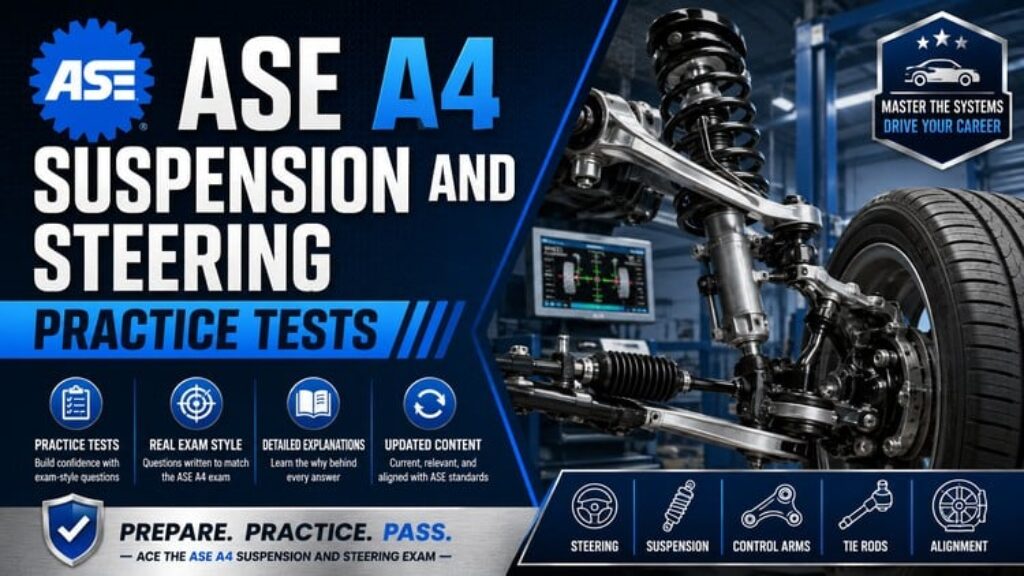
Prepare confidently for the ASE A4 Suspension and Steering Certification Test with 600 comprehensive practice questions and detailed answer explanations.
The ASE A4 – Suspension and Steering Practice Tests course is designed for automotive technicians, automotive students, apprentices, mechanics, service professionals, and ASE candidates who want to test and strengthen their suspension, steering, wheel alignment, and wheel-and-tire knowledge before attempting the ASE A4 certification exam.
This course contains 600 carefully developed practice questions covering the major diagnostic and repair areas associated with the ASE A4 Suspension and Steering test.
Rather than focusing only on memorization, the questions are designed to strengthen your ability to analyze symptoms, understand component operation, interpret measurements, identify likely causes of vehicle problems, and determine the appropriate repair or diagnostic procedure.
The practice tests cover traditional mechanical and hydraulic systems as well as modern electric power steering, electronically controlled steering, electronic suspension, sensors, actuators, control modules, and calibration procedures.
Whether you are preparing for your first ASE A4 exam, working toward ASE Master Automobile Technician status, refreshing previously learned skills, or strengthening your professional automotive knowledge, these practice tests provide extensive opportunities to assess your readiness.
Key Topics Covered
1. Steering System Diagnosis and Repair
Questions cover:
-
Steering system operation
-
Steering columns
-
Intermediate steering shafts
-
Steering shaft U-joints
-
Flexible steering couplings
-
Collapsible steering columns
-
Tilt steering systems
-
Telescoping steering columns
-
Steering wheel components
-
Steering-column-mounted controls
-
Steering column noises
-
Excessive steering effort
-
Steering looseness
-
Steering binding
-
Steering vibration
-
Steering wheel free play
-
Steering pull and lead
-
Steering returnability
-
Steering gear diagnosis
-
Conventional steering gears
-
Rack-and-pinion steering
-
Steering gear mounting
-
Rack mounting bushings
-
Steering gear adjustment
-
Worm bearing preload
-
Sector shaft lash
-
Steering linkage inspection
-
Pitman arms
-
Idler arms
-
Center links
-
Drag links
-
Relay rods
-
Tie rods
-
Inner tie-rod ends
-
Outer tie-rod ends
-
Tie-rod adjusting sleeves
-
Steering dampers
2. Hydraulic Power Steering Systems
Questions cover:
-
Power steering system operation
-
Power steering pumps
-
Power steering fluid
-
Correct fluid identification
-
Fluid level inspection
-
Fluid condition
-
Contaminated fluid
-
Aerated power steering fluid
-
Power steering reservoirs
-
Power steering hoses
-
Pressure hoses
-
Return hoses
-
Fittings
-
O-rings
-
Power steering coolers
-
Filters
-
Pump belts
-
Pulleys
-
Belt tensioners
-
Pump mounting brackets
-
Power steering leaks
-
Pump noises
-
Pump vibration
-
Hard steering
-
Intermittent steering assist
-
Pressure testing
-
Flow testing
-
System bleeding
-
Steering assist diagnosis
3. Electric and Electronic Power Steering
Questions cover:
-
Electric Power Steering (EPS)
-
Electronic Power Steering
-
Steering assist motors
-
Torque sensors
-
Steering angle sensors
-
Position sensors
-
Electronic control modules
-
Steering switches
-
Actuators
-
Wiring and harnesses
-
Connectors
-
Power and ground circuits
-
EPS warning indicators
-
Diagnostic trouble codes
-
Reduced steering assist
-
Intermittent assist
-
Steering system initialization
-
Steering angle sensor calibration
-
EPS system calibration
-
Electronic steering diagnosis
4. Steering Column and Safety Systems
Questions cover:
-
Steering column inspection
-
Column bearings
-
Intermediate shafts
-
Collapsible steering columns
-
Steering wheel removal
-
Steering wheel installation
-
Clock springs
-
Steering wheel controls
-
Airbag-equipped steering wheels
-
Supplemental Restraint System precautions
-
Airbag disabling procedures
-
Airbag enabling procedures
-
Proper handling of airbag components
-
Steering column sensor installation
-
Steering column calibration
5. Front Suspension Systems
Questions cover:
-
Independent front suspension
-
MacPherson strut suspension
-
Short-long-arm suspension
-
Control arms
-
Upper control arms
-
Lower control arms
-
Control-arm bushings
-
Ball joints
-
Upper ball joints
-
Lower ball joints
-
Steering knuckles
-
Spindles
-
Wheel hubs
-
Wheel bearings
-
Coil springs
-
Torsion bars
-
Spring insulators
-
Strut rods
-
Radius rods
-
Stabilizer bars
-
Stabilizer links
-
Stabilizer bushings
-
Suspension bump stops
-
Jounce bumpers
-
Rebound bumpers
-
Ride height
-
Front suspension noise
-
Suspension looseness
-
Suspension component wear
6. Rear Suspension Systems
Questions cover:
-
Independent rear suspension
-
Solid rear suspension
-
Multi-link suspension
-
Rear control arms
-
Lateral links
-
Trailing arms
-
Track bars
-
Panhard rods
-
Rear suspension bushings
-
Rear coil springs
-
Leaf springs
-
Spring shackles
-
Spring hangers
-
Spring insulators
-
Rear shocks
-
Rear struts
-
Stabilizer bars
-
Suspension mounting points
-
Rear ride-height concerns
-
Rear suspension noises
-
Rear suspension damage
-
Rear suspension alignment concerns
7. Shocks, Struts, Springs and Ride Control
Questions cover:
-
Shock absorbers
-
Struts
-
Strut cartridges
-
Strut assemblies
-
Upper strut mounts
-
Strut bearings
-
Coil springs
-
Leaf springs
-
Torsion bars
-
Air springs
-
Load-leveling systems
-
Suspension compressors
-
Air suspension lines
-
Height sensors
-
Electronic dampers
-
Adaptive suspension
-
Electronically controlled suspension
-
Excessive bouncing
-
Harsh ride
-
Vehicle sagging
-
Uneven ride height
-
Body roll
-
Nose dive
-
Suspension noise
-
Shock and strut leakage
-
Ride-control diagnosis
8. Wheel Alignment Fundamentals
Questions cover:
-
Wheel alignment principles
-
Alignment terminology
-
Preliminary alignment inspection
-
Vehicle ride height
-
Tire pressure before alignment
-
Suspension inspection before alignment
-
Steering inspection before alignment
-
Alignment equipment setup
-
Alignment specifications
-
Alignment measurements
-
Four-wheel alignment
-
Steering wheel centering
-
Alignment adjustment procedures
9. Camber, Caster and Toe
Questions cover:
Camber
-
Positive camber
-
Negative camber
-
Camber-related tire wear
-
Camber-related pulling
-
Cross-camber
Caster
-
Positive caster
-
Negative caster
-
Caster and steering stability
-
Steering returnability
-
Caster-related pulling
-
Cross-caster
Toe
-
Toe-in
-
Toe-out
-
Total toe
-
Individual toe
-
Toe-related tire wear
-
Feathered tire wear
-
Steering wheel position
-
Toe adjustment
10. Advanced Wheel Alignment Angles
Questions cover:
-
Steering Axis Inclination (SAI)
-
Included angle
-
Thrust angle
-
Toe-out-on-turns
-
Turning angle
-
Setback
-
Geometric centerline
-
Vehicle centerline
-
Thrust line
-
Scrub radius concepts
-
Wheelbase differences
-
Bent suspension component diagnosis
-
Bent steering knuckles
-
Frame or structural damage indicators
-
Alignment angle relationships
-
Non-adjustable alignment angles
11. Alignment Problem Diagnosis
Questions cover:
-
Vehicle pulling
-
Vehicle drifting
-
Steering wheel off-center
-
Poor steering return
-
Vehicle wandering
-
Darting
-
Memory steer
-
Tire wear after alignment
-
Unequal caster
-
Unequal camber
-
Incorrect toe
-
Incorrect thrust angle
-
Ride-height-related alignment problems
-
Worn suspension components
-
Worn steering components
-
Tire-induced pull
-
Road crown effects
-
Alignment measurement interpretation
-
Identifying bent or damaged components
12. Wheels and Tires
Questions cover:
-
Tire inspection
-
Tire identification
-
Tire sizing
-
Tire load ratings
-
Speed ratings
-
Tire pressure
-
Tire tread depth
-
Tire condition
-
Tire rotation
-
Tire mounting
-
Tire demounting
-
Directional tires
-
Asymmetric tires
-
Wheel inspection
-
Steel wheels
-
Alloy wheels
-
Wheel damage
-
Wheel fasteners
-
Lug nuts
-
Wheel torque procedures
-
Hub surfaces
-
Tire replacement considerations
13. Tire Wear Diagnosis
Questions cover:
-
Center tread wear
-
Shoulder wear
-
One-sided wear
-
Feathering
-
Cupping
-
Scalloping
-
Heel-and-toe wear
-
Camber wear
-
Toe wear
-
Underinflation wear
-
Overinflation wear
-
Suspension-related tire wear
-
Balance-related tire wear
-
Alignment-related tire wear
14. Wheel Balancing and Vibration Diagnosis
Questions cover:
-
Static imbalance
-
Dynamic imbalance
-
Wheel balancing
-
Balance weights
-
Road-force variation concepts
-
Tire radial force variation
-
Radial runout
-
Lateral runout
-
Wheel runout
-
Tire runout
-
Hub runout
-
Vehicle vibration
-
Steering wheel vibration
-
Seat/floor vibration
-
Speed-related vibration
-
Tire and wheel matching
-
Wheel centering problems
15. Tire Pressure Monitoring Systems
Questions may include concepts related to:
-
Tire Pressure Monitoring Systems (TPMS)
-
Direct TPMS
-
Indirect TPMS
-
TPMS sensors
-
Sensor identification
-
Sensor service precautions
-
Valve-stem sensors
-
TPMS warning lights
-
Tire pressure adjustment
-
System relearn procedures
-
Sensor initialization
-
Wheel and tire service precautions
Question Styles Included
The course will use a variety of question formats to closely test practical automotive knowledge.
Questions will include:
-
Standard multiple-choice questions
-
Real-world diagnostic scenarios
-
Technician A / Technician B questions
-
Symptom-based troubleshooting questions
-
Component identification questions
-
System operation questions
-
Measurement and specification questions
-
Inspection procedure questions
-
Repair procedure questions
-
Steering noise diagnosis
-
Suspension noise diagnosis
-
Tire wear diagnosis
-
Vehicle pull diagnosis
-
Vibration diagnosis
-
Wheel alignment interpretation
-
Component failure identification
-
Electronic steering diagnostic scenarios
-
Electronic suspension diagnostic scenarios
-
Service and adjustment procedure questions
What Makes This Course Useful?
The goal of this course is not simply to memorize answers.
Automotive technicians must be able to analyze symptoms and determine the most likely cause of a problem.
For example, a vehicle may have:
-
Hard steering
-
Excessive steering play
-
Steering wheel vibration
-
Vehicle pulling
-
Uneven tire wear
-
Suspension noise
-
Poor steering returnability
-
Excessive bouncing
-
Incorrect ride height
-
An off-center steering wheel
The learner must determine whether the problem originates from the steering system, suspension system, wheel alignment, wheel/tire assembly, hydraulic assist system, or electronic steering system.
Each practice question is designed to strengthen understanding of:
-
Component operation
-
Failure symptoms
-
Diagnostic procedures
-
Inspection techniques
-
Measurements
-
Test results
-
Repair decisions
-
Service procedures
Detailed explanations are provided after each question so learners can understand why the correct answer is correct and reinforce the underlying technical concept.
Disclaimer
This practice-test course is an independent educational resource designed to help learners prepare for the ASE A4 Suspension and Steering certification examination.
It is not affiliated with, endorsed by, sponsored by, or officially connected with the National Institute for Automotive Service Excellence (ASE).
ASE and related certification names and trademarks belong to their respective trademark owners.
These practice tests should be used alongside appropriate automotive study materials, technical references, hands-on experience, and the official ASE study guide.



![[DE] KI-Masterclass: Vom Anfänger zum KI-Helden](https://courses.impodays.com/wp-content/uploads/2026/01/6584541_734c_2-100x56.jpg)



![[PT] Masterclass de Engenharia de IA: Do Zero ao Herói da IA](https://courses.impodays.com/wp-content/uploads/2025/05/6584543_c6a8_2-100x56.jpg)
![[ES] Bootcamp de IA Práctica y Certificación en 7 Días](https://courses.impodays.com/wp-content/uploads/2025/10/6587237_acc6_2-100x56.jpg)