Advertisements

Arduino Sensors & Block Coding for Beginners.

Advertisements
Learn to program Arduino sensors without complex code.
5
5/5
(4) Ratings
5 students
Created by Devarsh Shah
Advertisements

What you'll learn

  • Understand how different Arduino sensors work and how they interact with microcontrollers in simple step-by-step lessons.
  • Learn to connect and configure sensors with Arduino by building circuits and understanding sensor outputs and signal behavior.
  • Program sensors using simple block-based coding that helps beginners understand the logic behind embedded programming.
  • Read sensor data and control outputs such as LEDs, buzzers, and other components using visual programming methods.
  • Understand practical applications of sensors such as distance detection, temperature monitoring, light sensing, and motion detection.
  • Understand practical applications of sensors such as distance detection, temperature monitoring, light sensing, and motion detection.
  • Learn how to design simple sensor-based circuits and test them using simulation before implementing them in real hardware.
  • Gain a strong foundation in Arduino sensor interfacing that prepares learners for robotics, IoT, and electronics projects.
This course includes:
3.5 total hours on-demand video
0 articles
0 downloadable resources
12 lessons
Full lifetime access
Access on mobile and TV
Certificate of completion
Advertisements

Course content

Requirements

  • A laptop or desktop computer with internet access to run the simulation software and programming environment.
  • No prior knowledge of Arduino, electronics, or programming is required. Everything is explained from the very basics.
  • Most exercises are performed in simulation, so hardware is not required to complete the course.
  • Learners who want to practice physically may optionally use an Arduino board and basic sensor modules.
  • Learners who want to practice physically may optionally use an Arduino board and basic sensor modules.

Description

Welcome to “Arduino Sensors & Block Coding for Beginners.”

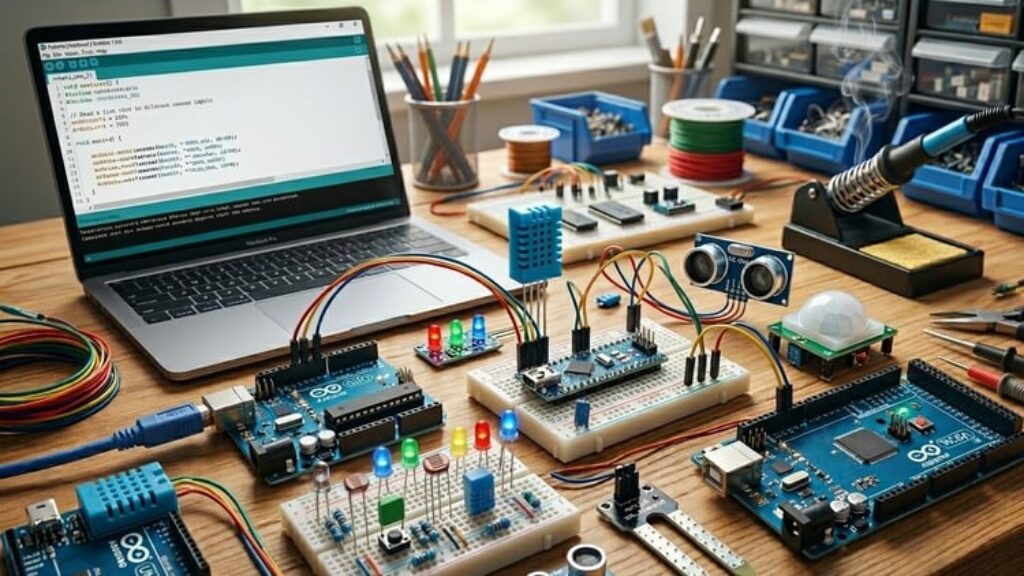
This course is designed to help you understand how different sensors work with the Arduino Uno and how they can be programmed using a simple block-based coding approach. The course focuses on practical learning, allowing you to explore sensor behavior, circuit connections, and programming logic in a clear and beginner-friendly way.

You will start by understanding the basics of sensors and how they interact with a microcontroller. Step by step, you will learn how to connect sensors, read their outputs, and control them using visual block coding. This approach makes it easier for beginners to understand programming logic without needing prior coding experience.

The course includes demonstrations, practical examples, and activities that help you build confidence in working with sensor-based circuits. By observing how sensors respond to environmental changes and writing simple programs to process their signals, you will gain a solid understanding of how sensing systems work in real electronic applications.

What you will learn:

  • Fundamentals of sensors and their applications.

  • How sensors interface with Arduino.

  • Reading sensor data using block coding.

  • Understanding circuit connections and signal flow.

  • Practical exercises to reinforce learning.

Who This Course Is For:

  • Students, engineers, developers, and hobbyists who want to learn and understand Arduino, sensors and electronics better.

  • Beginners learning Arduino for the first time.

  • Anyone interested in building hardware projects or prototypes using Arduino.

This course is ideal for students, beginners, and hobbyists who want to explore Arduino sensors and understand how to program them in a simple and practical way.

Looking forward to seeing you in the course.

Happy Learning.

Who this course is for:

  • Students who want to learn how sensors work and how to use them in Arduino-based electronics and robotics projects.
  • Beginners who want to start learning electronics and embedded systems without complex programming.
  • Hobbyists and makers interested in building sensor-based Arduino projects and experimenting with electronics.
  • Engineering students who want practical exposure to sensors and microcontroller programming.
  • Teachers and educators looking for a simple way to introduce Arduino and sensor concepts to beginners.
  • Anyone curious about how real-world devices use sensors to interact with the environment.
Advertisements
VVFFFIRST
Advertisements
Advertisements
Free Online Courses with Certificates
Logo
Register New Account