Advertisements

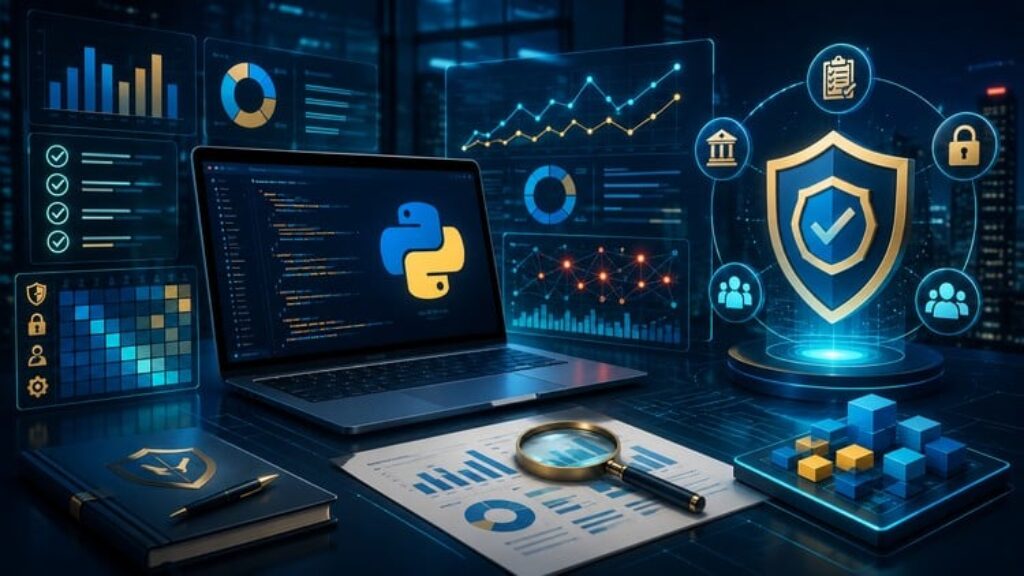
Python for IT Auditors: Controls, Fraud & GRC Analytics

Advertisements
Build auto-graded Python audit tests for access, transactions, fraud, compliance evidence & risk analytics
1
1/5
(85) Ratings
16 students
Created by Dr. Amar Massoud
Advertisements

What you'll learn

  • Write Python audit tests from scratch — no prior programming required
  • Use pandas and NumPy to test full populations instead of samples
  • Detect duplicate payments, split purchases, and after-hours journal entries
  • Reconcile terminated employees against active accounts and model SoD conflicts
  • Apply Benford’s Law and cross-system matching to surface fraud indicators
  • Reconcile general ledger to subledger and find sequence gaps
  • Test compliance evidence for expiry and compute control exception rates
  • Perform stratified and monetary-unit sampling and rank remediation by risk
  • Build a reusable Continuous Controls Monitoring (CCM) test suite
This course includes:
4 total hours on-demand video
0 articles
0 downloadable resources
40 lessons
Full lifetime access
Access on mobile and TV
Certificate of completion
Advertisements

Course content

Requirements

  • No programming experience needed — Python is taught from the ground up
  • A computer with Python 3 installed (free); we use only pandas and NumPy
  • Basic familiarity with auditing or internal controls is helpful but not required

Description

This course contains the use of Artificial Intelligence.

Most IT-audit courses stop at theory. This one puts a Python interpreter in your hands and has you write the actual tests — the same continuous-controls, fraud-detection, and GRC analytics that modern audit teams run over full populations instead of tiny samples.

You start from zero Python. Within a few lectures you are reading CSV extracts, then moving into pandas and NumPy to build real Computer-Assisted Audit Techniques (CAATs). Every technique is grounded in NovaBridge Logistics, a realistic model company whose ERP, HR, and IAM systems generate the datasets you test throughout the course — leaver accounts still active, duplicate payments, split purchases under approval thresholds, weekend journal entries, Benford’s-Law anomalies, vendor-employee collusion, GL-to-subledger breaks, expired compliance evidence, and more.

You will learn to detect duplicate invoices and payments, find purchases split below approval limits, spot after-hours journal entries, reconcile terminated employees against active accounts, model segregation-of-duties conflicts, reconcile ledgers, flag missing or expired evidence, calculate exception rates and audit priorities, perform stratified and monetary-unit sampling, and rank remediation by risk. The course finishes with a Continuous Controls Monitoring capstone where you assemble your tests into a single reusable audit suite.

By the end you will have a portfolio of runnable Python audit tests you can adapt to real engagements — and the confidence to bring data analytics into your audit work.

Who this course is for:

  • IT auditors and internal auditors who want hands-on data-analytics skills
  • GRC and compliance analysts moving from spreadsheets to code
  • CISA candidates and accounting professionals expanding into analytics
  • Anyone who wants to automate control testing and fraud detection with Python
Advertisements
59DF52B04DCAFF71979B
Advertisements
Advertisements
Free Online Courses with Certificates
Logo
Register New Account