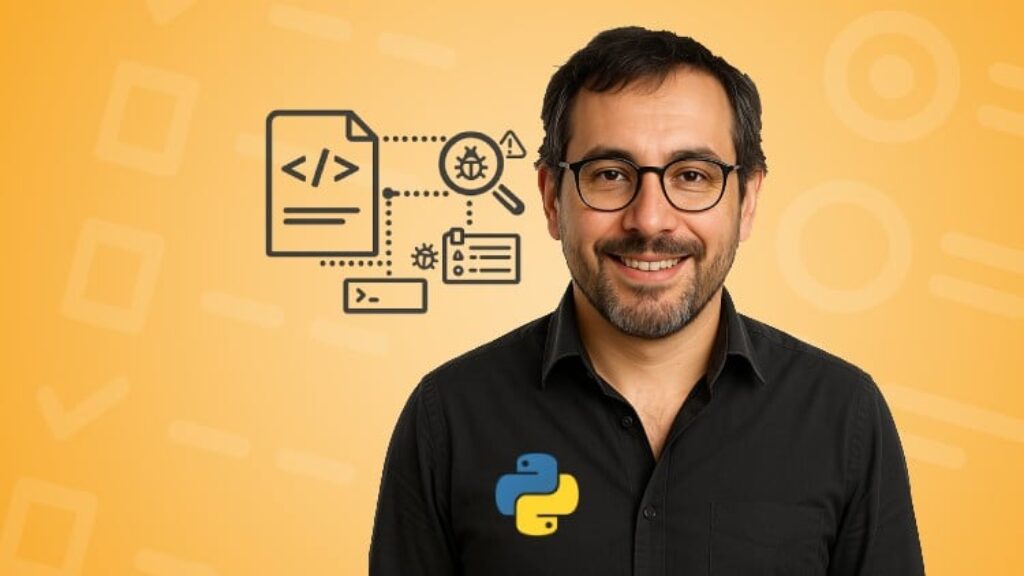
Master the art of identifying and resolving code issues with the most comprehensive Python Debugging and Logging Practice Exams available on Udemy. This course is meticulously designed to bridge the gap between writing code and maintaining production-ready software.
Why Serious Learners Choose These Practice Exams
Serious learners understand that writing code is only 20% of the job; the remaining 80% is often spent debugging and monitoring. These practice exams go beyond simple syntax checks. They challenge your ability to trace execution flow, implement robust logging levels, and utilize advanced debugging tools like pdb. By choosing these exams, you are investing in a simulated environment that mirrors the high-pressure situations encountered by professional software engineers.
Course Structure
Our curriculum is organized into six logical progression levels to ensure a steady learning curve:
-
Basics / Foundations: This section covers the fundamental differences between print statements and logging. You will be tested on basic Python error types (SyntaxError, TypeError, ValueError) and how to read a standard traceback.
-
Core Concepts: Dive deep into the logging module. Questions focus on the hierarchy of log levels (DEBUG, INFO, WARNING, ERROR, CRITICAL), standard formatting strings, and basic exception handling using try…except blocks.
-
Intermediate Concepts: Here, we explore configuration files and handlers. You will learn how to route logs to different destinations like files and streams simultaneously, and how to use the logging.basicConfig method effectively.
-
Advanced Concepts: This module focuses on custom Loggers, Filters, and Adapters. You will tackle complex scenarios involving the pdb module, setting breakpoints, and inspecting local/global variables during runtime.
-
Real-world Scenarios: Test your skills against practical problems. This includes debugging multithreaded applications, logging in distributed systems, and handling silent failures in large-scale data processing scripts.
-
Mixed Revision / Final Test: A comprehensive final exam that pulls from all previous sections. This timed assessment is designed to test your retention and speed, ensuring you are ready for any real-world Python challenge.
Sample Practice Questions
Question 1
You are using the Python logging module. By default, if no configuration is applied, what is the lowest severity level that will be printed to the console?
-
Option 1: DEBUG
-
Option 2: INFO
-
Option 3: WARNING
-
Option 4: ERROR
-
Option 5: CRITICAL
CORRECT ANSWER: Option 3
CORRECT ANSWER EXPLANATION: By default, the Python logging module sets the threshold level to WARNING. This means that any log messages with a severity of WARNING, ERROR, or CRITICAL will be captured, while DEBUG and INFO messages will be ignored unless the configuration is explicitly changed.
WRONG ANSWERS EXPLANATION:
-
Option 1: DEBUG is the lowest level, but it is not the default. It requires manual configuration to level=logging.DEBUG.
-
Option 2: INFO is higher than DEBUG but still below the default threshold of WARNING.
-
Option 4: ERROR messages are captured, but this is not the lowest level captured; WARNING is lower and also captured.
-
Option 5: CRITICAL is the highest level. While it is printed, it is not the “lowest” default level.
Question 2
When using the pdb module to debug a script, which command allows you to execute the current line and stop at the next execution point, even if it is inside a function being called?
-
Option 1: n (next)
-
Option 2: s (step)
-
Option 3: c (continue)
-
Option 4: r (return)
-
Option 5: q (quit)
CORRECT ANSWER: Option 2
CORRECT ANSWER EXPLANATION: The s (step) command executes the current line and stops at the first possible occasion. If the current line is a function call, pdb will “step into” that function, allowing you to debug the internal logic of the called function.
WRONG ANSWERS EXPLANATION:
-
Option 1: The n (next) command continues execution until the next line in the current function is reached, effectively “stepping over” function calls.
-
Option 3: The c (continue) command resumes normal execution and only stops if a breakpoint is encountered.
-
Option 4: The r (return) command continues execution until the current function returns a value.
-
Option 5: The q (quit) command aborts the debugger and exits the program entirely.
Course Benefits
Welcome to the best practice exams to help you prepare for your Python Debugging & Logging.
-
You can retake the exams as many times as you want.
-
This is a huge original question bank.
-
You get support from instructors if you have questions.
-
Each question has a detailed explanation.
-
Mobile-compatible with the Udemy app.
-
30-days money-back guarantee if you’re not satisfied.
We hope that by now you’re convinced! And there are a lot more questions inside the course.