Advertisements

Linear Algebra for A.I, Data Science & Quantum Computing

Advertisements
Engineers Playground: Master Vectors, Matrices, Unitary transformations for Machine Learning, AI & More
1
1/5
(86) Ratings
1 students
Created by Infusion X
Advertisements

What you'll learn

  • Build a strong conceptual and mathematical foundation in Linear Algebra from first principles.
  • Understand vectors, vector spaces, subspaces, bases, dimensions, and linear transformations.
  • Master matrix operations, matrix algebra, inverses, determinants, and systems of linear equations.
  • Learn eigenvalues, eigenvectors, diagonalization, orthogonality, and orthonormal bases.
  • Apply Linear Algebra concepts to Artificial Intelligence, Machine Learning, Deep Learning, and Data Science.
  • Understand the mathematics behind Principal Component Analysis (PCA), dimensionality reduction, and optimization.
  • Learn how Linear Algebra powers Computer Vision, Robotics, Computer Graphics, and Signal Processing.
  • Develop a solid mathematical foundation for Quantum Computing, including complex vector spaces, unitary transformations, and quantum states.
  • Solve real-world engineering and computational problems using Linear Algebra techniques.
  • Strengthen mathematical reasoning, analytical thinking, and problem-solving skills.
  • Build the confidence required to pursue advanced topics such as Machine Learning, Numerical Methods, Scientific Computing, and Quantum Information Science.
This course includes:
6 total hours on-demand video
0 articles
0 downloadable resources
40 lessons
Full lifetime access
Access on mobile and TV
Certificate of completion
Advertisements

Course content

Requirements

  • No prior knowledge of Linear Algebra is required—this course starts from the fundamentals.
  • A basic understanding of high school mathematics (algebra and arithmetic) is helpful but not mandatory.
  • No programming experience is required.
  • No prior knowledge of Artificial Intelligence, Data Science, or Quantum Computing is required.
  • A willingness to think logically, solve problems, and explore mathematical concepts.
  • Curiosity about how mathematics powers modern technologies such as AI, Machine Learning, Robotics, Computer Graphics, and Quantum Computing.

Description

Artificial Intelligence is transforming industries. Data Science is driving decisions. Quantum Computing is redefining the future of computation. Behind each of these revolutionary fields lies a common mathematical language— Linear Algebra

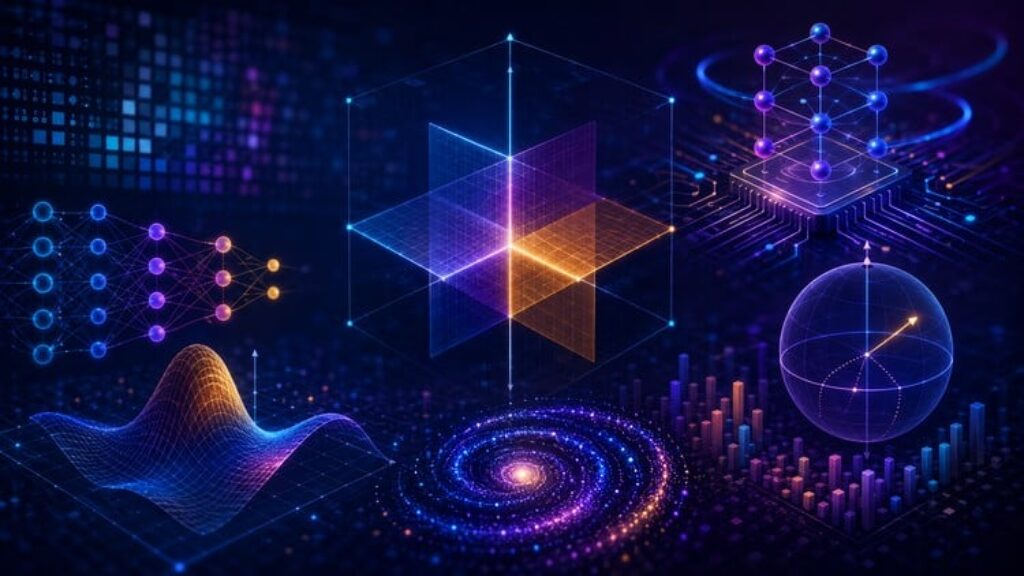
Linear Algebra is far more than a university subject or a collection of matrix operations. It is the framework through which machines learn from data, algorithms recognize patterns, robots understand movement, recommendation systems predict preferences, computer graphics render realistic worlds, and quantum computers manipulate information at a fundamentally new level.

This course has been carefully designed to bridge the gap between traditional mathematics and modern technology. Rather than memorizing formulas or solving repetitive textbook problems, you will develop a deep conceptual understanding of why linear algebra works and how it powers today’s most influential technologies.

Every concept is introduced from first principles, explained with intuitive visualizations, strengthened through mathematical reasoning, and connected to practical engineering applications. Whether you are learning about vectors, matrices, vector spaces, eigenvalues, or matrix decompositions, you will constantly discover how these ideas appear in Machine Learning, Deep Learning, Data Science, Robotics, Computer Vision, Computer Graphics, Signal Processing, and Quantum Computing.

Unlike many conventional linear algebra courses that emphasize abstract theory without context, this course is built specifically for engineers, computer scientists, and technology enthusiasts who want to understand the mathematics behind intelligent systems. The emphasis is not only on solving problems but also on developing mathematical intuition—the ability to see how different concepts connect and why they matter in real-world engineering.

This course is suitable for complete beginners as well as students who wish to strengthen their mathematical foundations before studying advanced topics such as Machine Learning, Deep Learning, Optimization, Numerical Methods, Scientific Computing, and Quantum Information Science. Every topic is presented in a logical progression, allowing you to build confidence step by step while gradually moving toward advanced applications.

As part of the Engineer’s Playground series, this course forms one of the core pillars of a complete Engineering Mathematics curriculum.

By the end of this course, you will not only be able to perform linear algebra computations with confidence but also understand the mathematical thinking that drives many of the world’s most important technologies. More importantly, you will develop the ability to approach engineering problems with clarity, precision, and confidence—skills that remain valuable throughout your academic and professional journey.

If you are ready to build a strong mathematical foundation for Artificial Intelligence, Data Science, Computer Science, and Quantum Computing, then welcome to the course.

Let’s begin the journey..

Who this course is for:

  • Students who want to build a strong foundation in Linear Algebra from scratch.
  • Aspiring AI and Machine Learning Engineers.
  • Future Data Scientists and Data Analysts.
  • Deep Learning and Neural Network enthusiasts.
  • Computer Science and Engineering students.
  • Software Engineers who want to strengthen their mathematical foundations.
  • Robotics and Computer Vision enthusiasts.
  • Quantum Computing beginners and researchers.
  • Students preparing for higher studies in Artificial Intelligence or Data Science.
  • Professionals transitioning into AI, Machine Learning, or Data Science careers.
  • Anyone interested in understanding the mathematics behind modern technology.
  • Learners preparing for technical interviews, university courses, or research.
  • Engineers who want to develop mathematical intuition instead of memorizing formulas.
  • Technology enthusiasts curious about how vectors, matrices, and transformations power real-world applications.
  • Anyone who wants to confidently apply Linear Algebra to engineering and computational problems.
Advertisements
A9BF0D256B43C69F5964
Advertisements
Advertisements
Free Online Courses with Certificates
Logo
Register New Account