This course is designed to make learning Discrete Mathematics easy. It is well-arranged into targeted sections of focused lectures and extensive worked examples to give you a solid foundation in the key topics from theory to applications.
The course is ideal for:
-
Discrete math students who want to be at the top of their class or get ahead of their class
-
Any person who is interested in mathematics and/or needs a refresher course
-
Any person who is undertaking a discipline that requires discrete math, including graphics, games programming, analysis of algorithms, digital electronics and logic circuits, cryptography, and so on
At the end of this course, you will have a strong foundation in one of the most important disciplines of Mathematics, which you will definitely come across if you are from a computer science or engineering background.
I welcome any questions and provide a friendly Q&A forum where I aim to respond to you in a timely manner.
Enrol today and you will get:
-
Lifetime access to refer back to the course whenever you need to
-
Friendly Q&A forum
-
Udemy Certificate of Completion
-
30-day money back guarantee
The course covers the following core units and topics of Discrete Mathematics:
1) Number bases and binary arithmetic
a) Introduction to number bases (decimal, binary, hexadecimal and octal)
b) Converting between decimal, binary, hexadecimal and octal
c) Adding, subtracting, multiplying and dividing binary and hexadecimal numbers
d) Subtracting using complements (ten’s and two’s complement)
e) Normalised scientific notation
f) Representing real numbers in computer memory using the IEEE754 floating point standard
2) Mathematical Computer Algorithms
a) Intro to computer algorithms and writing pseudocode
b) Horner’s algorithm for evaluating polynomials
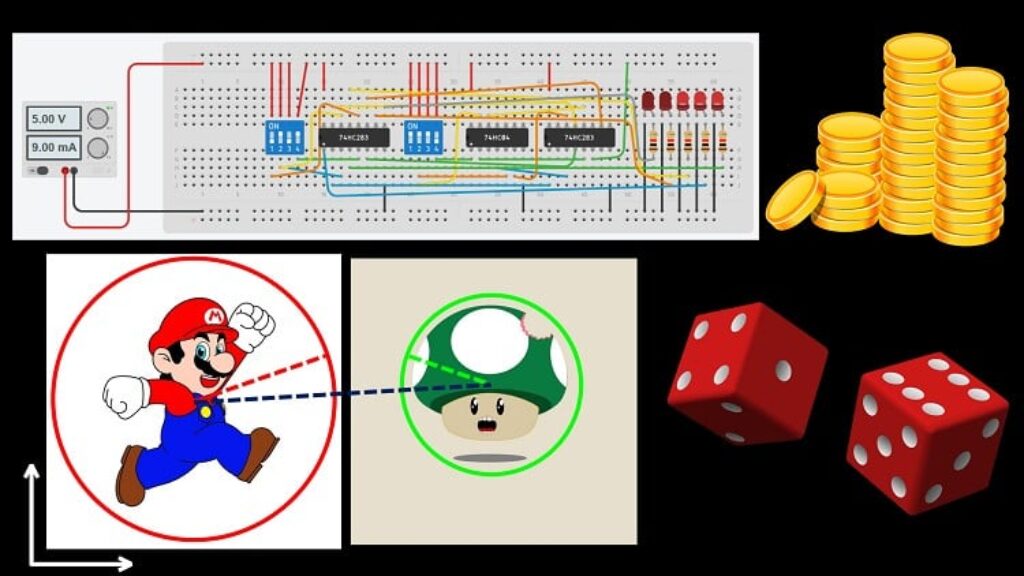
c) Collision detection algorithm in computer graphics and games
d) Encryption and decryption algorithm in cryptography
e) Lottery combination algorithm
3) Iteration and Recursion
a) Review of sigma (or summation) notation
b) Deriving the geometric and arithmetic series
c) Computing the Fibonacci sequence iteratively and recursively
d) Factorial sequence recurrence relation
4) Recurrence Relations
a) Intro to recurrence relations, standard form and properties
b) General solution to homogeneous first and second order recurrence relations
c) Method of solution for non-homogeneous second order recurrence relations
d) Special cases of the general solution to non-homogeneous second order recurrence relations
5) Computational Complexity of Algorithms and Big O Notation
a) Intro to computational complexity
b) Informal definition of Big O
c) Comparing growth rates, logarithms
d) Typical growth rates (constant, log, linear, quadratic and so on)
e) Formal definition of Big O
f) Refining Big O calculations using the triangle inequality and obtaining better constants
g) Big O analysis of search and sort algorithms
6) Combinatorics and Enumeration
a) Multiplication and addition rules of counting
b) Inclusion-exclusion principle
c) Permutations and the r-permutation
d) Permutations vs combinations
e) Combinations and multiple categories
f) Binomial theorem
g) Lexicographic ordering
h) Cartesian product of sets
7) Boolean Algebra
a) Review of functions
b) Binary operations
c) Boolean algebra, truth tables and axioms
d) Switching circuits
e) de Morgan’s laws, dual interchange
f) Equivalence of boolean expressions
g) Minterm and disjunctive normal form
8) Karnaugh Maps and Digital Logic Circuits
a) Karnaugh maps
b) Karnaugh map algorithm for obtaining the minimal boolean expression
c) Don’t care Karnaugh maps
d) Logic and logic circuits
e) How a breadboard works
f) Building a logic circuit with a NOT, AND and XOR gate
g) Building half-adder and full-adder logic circuits
h) Building two-bit and four-bit adder logic circuits
i) Building a two’s complement logic circuit for representing negative binary numbers
j) Building a logic circuit for subtracting binary numbers