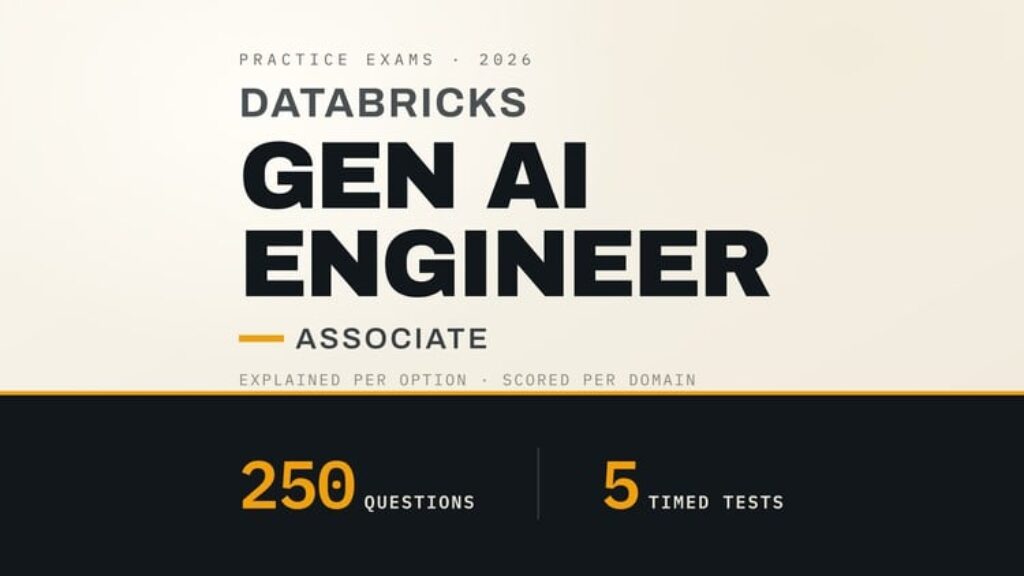
Are you ready to sit the Databricks Certified Generative AI Engineer Associate exam? The only honest way to find out is to be tested the way the exam tests you, before you pay the registration fee.
This course is 250 questions across five full-length practice exams, written to the official exam guide dated 18 March 2026. Every test carries the same domain distribution as the real exam: Design Applications, Data Preparation, Application Development, Assembling and Deploying Applications, Governance, and Evaluation and Monitoring, in the published proportions. Your score report after each attempt therefore tells you which domain to go back to, not just whether you passed.
That March 2026 revision matters more than a version bump usually does. Agent Bricks, managed and custom MCP servers, prompt version control and lifecycle management, AI Gateway tracking, custom scorers, agent monitoring, batch inference with ai_query, and multi-agent systems built on Genie Spaces all entered the outline in that revision. Practice material written before it simply cannot cover a large part of what the current exam asks, however well written it was.
The five tests rise in difficulty by changing how the question is put, not by reaching for more obscure facts. Test 1 is direct recall, one concept per question. Test 2 wraps the same knowledge in short practical situations and asks you to tell neighbouring services apart. Test 3 is the hinge: two options are both defensible and a single stated constraint decides between them. Test 4 goes to parameters, defaults, service limits and Unity Catalog privileges. Test 5 is a full-length timed simulation with long multi-constraint stems and domains deliberately mixed.
Every answer option has its own explanation saying why it is right or, if it is wrong, what that option actually is, because knowing the difference is what makes the distinction stick. Each question then closes with an overall explanation and a link to the official Databricks documentation page it came from.
The pass mark is 80% on the first four tests and 85% on the last. Both are set above what you need on exam day. Databricks does not publish a passing percentage for this exam, so building a margin beats aiming at a line nobody can see.
What this is not: real exam questions, a braindump, or a replacement for hands-on work in a Databricks workspace. It is a question bank and a readiness check, and it is written to be accurate.
Frequently Asked Questions
Are these real exam questions?
No. All questions are original and based on the official exam objectives. They match the style, difficulty and topic weighting of the real exam, without copying it.
How do the five practice tests work?
The tests increase in difficulty. Start with Practice Test 1 to find your weak areas, study those topics and move on. Practice Test 5 is the hardest and serves as a final check before your exam.
Can I review my answers?
Yes. After each attempt you can review every question, with a detailed explanation of why the correct answer is right and why the other options are wrong.
What score should I aim for?
Each test has a passing score in line with the real exam. Aim for consistent scores of 85% or higher before booking your exam. You can retake every test as often as you like.
Are the questions up to date?
Yes. The questions follow the current official exam objectives and are updated when the exam changes.
Is this course enough to pass the exam?
These tests check your readiness and show your knowledge gaps. Combine them with the official learning materials and hands-on practice for the best results.