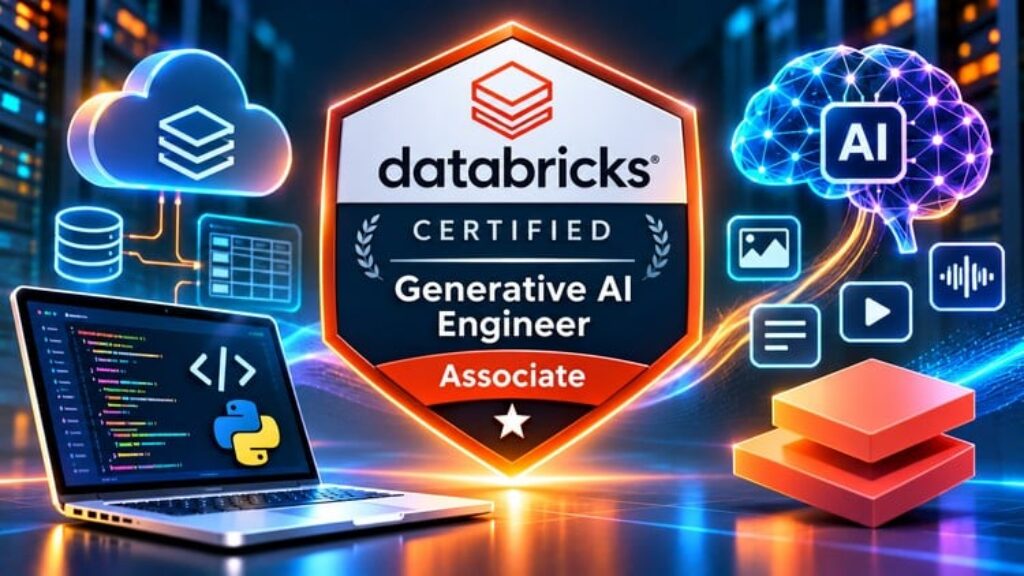
Prepare for the Databricks Certified Generative AI Engineer Associate exam with realistic, scenario-based practice
These practice tests are for engineers and data scientists preparing for the Databricks Certified Generative AI Engineer Associate exam. The exam checks whether you can design, build, deploy, govern, and evaluate LLM-powered and agentic applications on the Databricks Data Intelligence Platform. That work starts with preparing documents for retrieval and ends with monitoring a live application. This course helps you practice making those decisions with confidence.
Why this course
The exam rewards practical platform judgment. Several answers often look plausible, and one key phrase in the scenario rules out the rest. Each question gives you a realistic situation, such as choosing a chunking strategy for long contracts, picking the right serving option for an agent, protecting sensitive data with Unity Catalog, or diagnosing why a retrieval system returns irrelevant passages. You then choose the best approach. All questions are original, aligned with the current exam guide, and updated as Databricks evolves the platform and the exam.
What’s inside, by exam domain
-
Designing applications: breaking business problems into generative AI tasks, choosing prompts and model types, designing retrieval-augmented generation and agent workflows, and selecting tools
-
Data preparation: document parsing, chunking strategies, embeddings, Delta tables for source content, and building Vector Search indexes
-
Application development: prompt engineering, retrieval and re-ranking, building chains and agents with tool calling, the Mosaic AI Agent Framework, and choosing models for quality, latency, and cost
-
Assembling and deploying applications: logging and registering applications with MLflow, Model Serving endpoints, Foundation Model APIs, batch inference, and deployment patterns
-
Governance: Unity Catalog permissions and lineage, data protection and masking, AI Gateway guardrails, and responsible AI controls
-
Evaluation and monitoring: evaluating retrieval and generation quality, LLM-as-judge evaluation, MLflow tracing, inference tables, and monitoring cost and performance in production
How the explanations help you learn
Every question includes a detailed explanation for every answer option. You learn why the right choice fits the scenario, and why each of the others fails. A wrong option might use the wrong Databricks feature, compromise governance, or optimize for the wrong goal. Learning the reasoning this way prepares you for unfamiliar questions on exam day and for real work building generative AI applications.
Who it’s for
-
Generative AI and machine learning engineers, data scientists, and data engineers who build or plan to build LLM applications and agents on Databricks
Start practicing today
You get lifetime access, regular updates, and the protection of Udemy’s 30-day refund policy. Enroll now, find your weak domains, and go into the exam prepared.
Disclaimer
This course is an independent, unofficial study resource. It is not affiliated with, endorsed by, or sponsored by Databricks, Inc. Databricks, Delta Lake, MLflow, Unity Catalog, Mosaic AI, and related names are trademarks of their respective owners. They are used only to identify the exam this course helps you prepare for. All questions are original practice material and are not drawn from any Databricks exam.