This course contains the use of Artificial Intelligence.
[[ Unofficial Course ]]
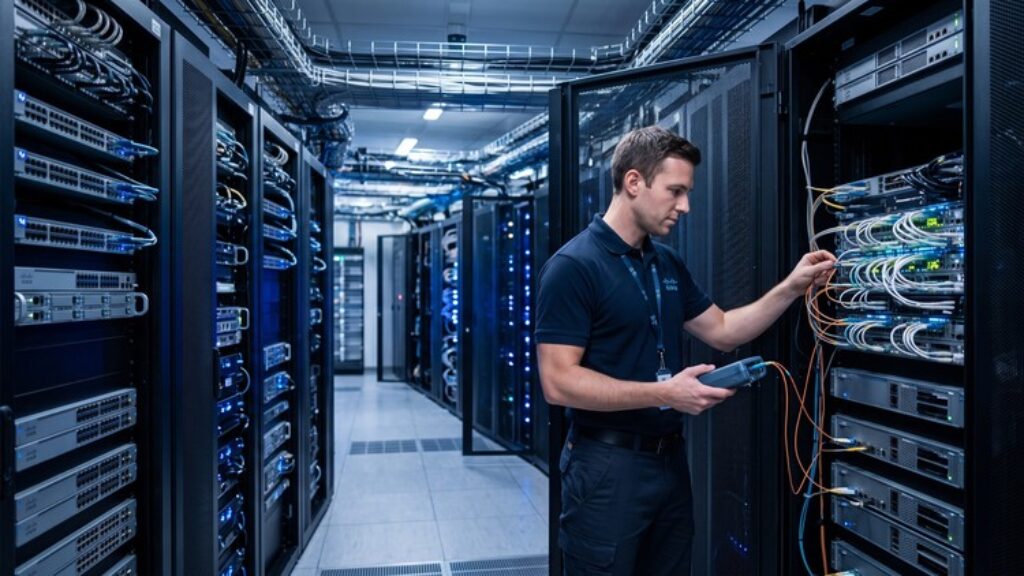
Step into the world of modern Cisco data center technologies and build a strong understanding of the architectures, networking technologies, storage platforms, compute infrastructure, automation concepts, and security mechanisms that power enterprise data centers. This comprehensive course is designed to help you understand how Cisco data center solutions work together to create scalable, resilient, secure, and highly available infrastructure.
You will begin by developing a solid foundation in data center architecture and Cisco Nexus technologies. The course explores traditional three-tier architectures and compares them with modern spine-leaf Clos designs, helping you understand why modern data centers have evolved toward highly scalable fabric architectures. You will learn about the Cisco Nexus hardware portfolio, NX-OS architecture, and the technologies used to build resilient and efficient data center networks. You will also explore Virtual Device Contexts (VDCs), their architecture and resource allocation, along with Virtual Port Channels (vPC), including their operational behavior and control-plane mechanics.
The course then moves into advanced Layer 2 and Layer 3 data center fabric technologies. You will learn how VXLAN provides scalable network virtualization and how its underlay network supports overlay connectivity. The course introduces multicast mechanisms used with VXLAN and explains how BGP EVPN functions as a control plane for modern multi-tenant data centers. You will examine symmetric and asymmetric Integrated Routing and Bridging (IRB), understand their differences and use cases, and explore Layer 2 and Layer 3 Data Center Interconnect (DCI) frameworks for connecting data center environments.
A major part of the course focuses on Cisco Application Centric Infrastructure (ACI). You will understand the ACI architecture, its policy-driven approach, and the role of the APIC controller. You will learn how tenants, VRFs, Bridge Domains, and Endpoint Groups (EPGs) are structured and how these logical constructs work together. The course also covers contracts, filters, and microsegmentation, giving you insight into how ACI implements policy-based security and application communication. You will explore ACI packet forwarding, endpoint learning, spine proxy operations, and architectural models such as ACI Multi-Pod and Multi-Site.
The course also provides a detailed introduction to data center storage networking. You will learn the fundamentals of Fibre Channel architecture, its protocol stack, and different Fibre Channel port types. You will explore important fabric services and operations including FLOGI, PLOGI, and Name Server functionality. The course covers VSAN architecture and Fibre Channel zoning mechanics, helping you understand how storage traffic can be logically separated and controlled. You will also learn about Fibre Channel over Ethernet (FCoE), Data Center Bridging (DCB), and IP-based storage technologies such as iSCSI and NVMe over Fabrics (NVMe-oF).
You will then explore Cisco Unified Computing System (UCS) and modern compute architecture. The course explains the roles of UCS Fabric Interconnects, I/O Modules, chassis, and server components within the UCS architecture. You will compare UCS Manager and Cisco Intersight and understand how unified fabric management is implemented. You will also learn about UCS abstraction concepts including pools, policies, service profiles, and service profile templates.
Network connectivity options such as End-Host Mode and Switch Mode are examined to help you understand how UCS integrates with the surrounding data center network. In addition, the course introduces Cisco HyperFlex architecture and the concepts behind its distributed file system and hyperconverged infrastructure model.
Finally, the course addresses data center security, monitoring, and infrastructure operations. You will explore Control Plane Policing (CoPP), microsegmentation, and Cisco TrustSec as important technologies for protecting data center infrastructure and controlling access to critical resources. You will also learn about telemetry, streaming analytics, and Nexus Dashboard operations, giving you a broader understanding of how modern data center environments can be monitored, analyzed, and managed.
Throughout the course, complex Cisco data center concepts are presented in a structured and practical manner so that you can develop a clear understanding of how networking, virtualization, storage, compute, security, and management technologies fit together. Rather than focusing only on individual technologies, the course helps you understand the relationships between the different components of a modern Cisco data center environment.
By the end of this course, you will have a comprehensive understanding of Cisco Nexus and NX-OS, spine-leaf architectures, vPC, VXLAN, BGP EVPN, IRB, DCI, Cisco ACI, Fibre Channel, VSANs, zoning, FCoE, iSCSI, NVMe-oF, Cisco UCS, Intersight, service profiles, HyperFlex, data center security, telemetry, and Nexus Dashboard operations.
This knowledge can help you strengthen your data center networking expertise and prepare for working with complex enterprise and cloud-scale infrastructure environments.
Whether you are a network engineer, data center engineer, systems administrator, infrastructure professional, security professional, architect, or IT professional looking to expand your Cisco expertise, this course provides a comprehensive journey through the technologies and architectural principles used in modern Cisco data centers.
Thank you