Advertisements

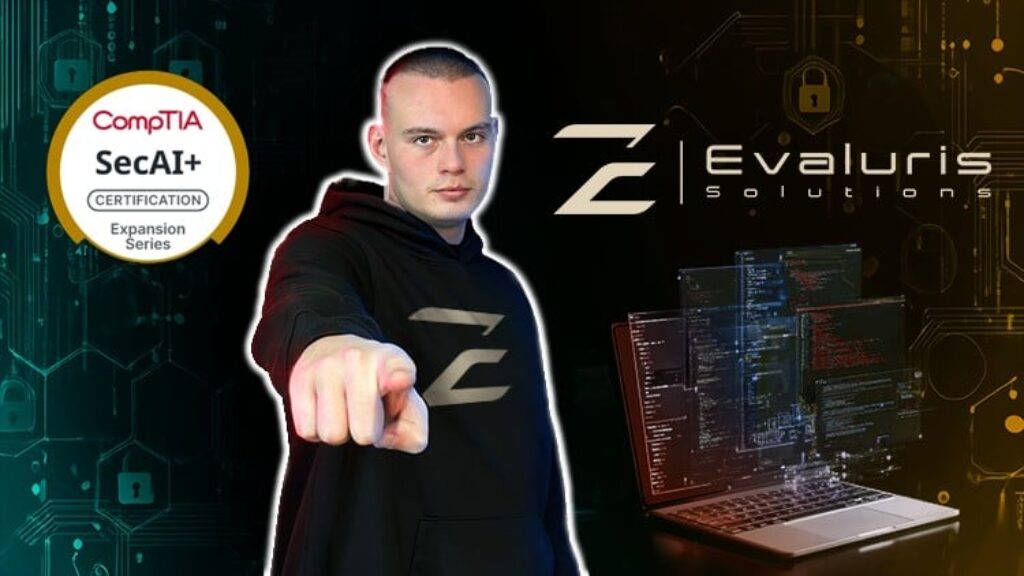
SecAI+ Exam Prep: Complete Guide to CompTIA SecAI+

Advertisements
Master AI security, adversarial attacks, governance, and compliance to pass the CompTIA SecAI+ CY0-001 exam in 2026.
1
1/5
(65) Ratings
0 students
Created by Adrian Găitan
Advertisements

What you'll learn

  • Compare and contrast AI types including generative AI, LLMs, transformers, GANs, and deep learning in applied cybersecurity contexts.
  • Implement security controls for AI systems including model guardrails, prompt firewalls, rate and token limits, and endpoint access controls.
  • Analyze AI attack scenarios and select compensating controls for prompt injection, model poisoning, model theft, and excessive agency.
  • Use AI-enabled tools including MCP servers, IDE plug-ins, and chatbots to automate threat detection, triage, and incident response workflows.
  • Defend against AI-driven threats including deepfakes, adversarial attacks, AI-generated malware, and automated social engineering at scale.
  • Navigate the EU AI Act, NIST AI RMF, ISO 42001, and OECD AI principles to meet enterprise AI governance and compliance obligations.
  • Apply data security controls including encryption, anonymization, masking, redaction, and minimization to protect AI systems and pipelines.
  • Use OWASP LLM Top 10, MITRE ATLAS, and the MIT AI Risk Repository to conduct structured AI threat modeling and risk assessments.
This course includes:
26.5 total hours on-demand video
0 articles
0 downloadable resources
79 lessons
Full lifetime access
Access on mobile and TV
Certificate of completion
Advertisements

Course content

Requirements

  • 3–4 years of IT experience with approximately 2 years of hands-on cybersecurity experience is recommended by CompTIA for this exam.
  • CompTIA Security+, CySA+, or PenTest+ certification or equivalent knowledge is strongly recommended before starting this course.
  • Basic understanding of networking, operating systems, and core cybersecurity concepts such as access control, encryption, and incident response.
  • Familiarity with cloud computing fundamentals and at least one cloud platform such as AWS, Azure, or Google Cloud is beneficial.
  • No prior AI or machine learning experience is required, all AI concepts including LLMs, transformers, and model training are taught from the ground up.
  • No specific software, lab environment, or hardware is required to complete the exam prep content in this course.
  • A willingness to engage with scenario-based questions and apply concepts across multiple domains simultaneously, as the real exam demands.
  • A current or target role in cybersecurity, analyst, engineer, architect, pentester, GRC, or DevSecOps,to contextualize the course material throughout.

Description

The CompTIA SecAI+ (CY0-001) is the first vendor-neutral certification built at the intersection of artificial intelligence and cybersecurity. It launched February 17, 2026, and validates that you can secure AI systems, defend against AI-driven threats, leverage AI for security operations, and govern AI responsibly within an enterprise environment. This course is the most complete exam preparation resource available for it.

Across 17 sections and 82 modules, every official CY0-001 exam objective from Version 2.0 of the CompTIA SecAI+ syllabus is covered in full. The course is structured to mirror the official domain weighting so you always know where your study time is going: Basic AI Concepts Related to Cybersecurity (17%), Securing AI Systems (40%), AI-Assisted Security (24%), and AI Governance, Risk and Compliance (19%).

Domain 1 builds your AI foundation from scratch. You will cover AI types including generative AI, machine learning, deep learning, transformers, LLMs, SLMs, and GANs, followed by prompt engineering techniques, data security in AI pipelines, RAG architecture, vector storage, embeddings, and security across the full AI development lifecycle.

Domain 2, the most heavily weighted domain at 40%, is where most candidates struggle and where this course goes deepest. You will work through AI-specific threat modeling using the OWASP LLM Top 10, OWASP ML Security Top 10, MITRE ATLAS, and the MIT AI Risk Repository. You will then cover every category of security control for AI systems: model guardrails, prompt firewalls, rate and token limits, access controls for models, data, agents and APIs, data security including encryption in transit, at rest and in use, and monitoring and auditing for AI quality and compliance. The AI attack taxonomy is covered in full across dedicated modules: prompt injection, indirect prompt injection, jailbreaking, model poisoning, data poisoning, hallucination exploitation, input manipulation, bias injection, guardrail bypass, model inversion, model theft, membership inference, AI supply chain attacks, transfer learning attacks, model skewing, output integrity attacks, insecure plug-in design, excessive agency, and model denial of service. Every attack type is paired with its specific compensating controls so you can answer scenario-based and performance-based questions with confidence.

Domain 3 covers how AI enables and enhances both defensive and offensive security operations: AI-powered tools including IDE plug-ins, browser plug-ins, CLI plug-ins, MCP servers, and chatbots, AI-driven attack vectors including deepfakes, AI-generated payloads, automated reconnaissance, and AI-enhanced social engineering, and automation of security tasks through low-code scripting, document synthesis, incident ticket management, AI agents, and CI/CD pipeline security.

Domain 4 covers the governance, risk, and compliance frameworks that now govern enterprise AI adoption globally: the EU AI Act risk tiers and compliance obligations, OECD AI principles, ISO 42001 and ISO 23894, the NIST AI Risk Management Framework across all four functions, responsible AI principles, AI risk categories including shadow AI and autonomous system risk, corporate AI policy, data sovereignty, private versus public model governance, third-party AI compliance evaluation, and GDPR applied to AI systems.

Every module closes with scenario-based application and targeted exam tips mapped to the specific CY0-001 objective. The SecAI+ is a new certification. Passing it in 2026 positions you ahead of the vast majority of the cybersecurity workforce in a specialization that is already creating dedicated job roles and increasing salary premiums across the industry.


Who this course is for:

  • Security analysts, engineers, and architects who are actively preparing to pass the CompTIA SecAI+ CY0-001 certification exam in 2026.
  • IT professionals with an existing CompTIA certification stack, Security+, CySA+, or PenTest+, who want to add a dedicated AI security credential.
  • SOC analysts and threat hunters who want to leverage AI for anomaly detection, alert triage, behavioral analysis, and incident response acceleration.
  • Pentesters and red team operators expanding into AI attack vectors, AI red teaming, and AI-assisted offensive security techniques and tooling.
  • GRC professionals and compliance officers who need to operationalize the EU AI Act, NIST AI RMF, and responsible AI frameworks within their organizations.
  • DevSecOps engineers and platform engineers integrating AI into CI/CD pipelines who need to understand the full AI security and governance implications.
  • Security professionals in the GCC, India, the US, the EU, and Canada targeting the fast-growing AI security specialization and its associated role premium.
  • Anyone building a credentialed foundation at the intersection of artificial intelligence and cybersecurity before the SecAI+ becomes a standard market requirement.
Advertisements
7F64ABAF0445A4AF528F
Advertisements
Advertisements
Free Online Courses with Certificates
Logo
Register New Account