Welcome to this Discrete Math course.
Discrete Mathematics is the math of distinct, countable objects (like integers or steps) rather than continuous, smooth lines (like calculus). It is the backbone of modern technology. It provides the core rules and logic required for programming, digital networks, computer security, and data analysis. In this course, you will be learning the core of Discrete Mathematics, namely:
1. “Set Theory (Sets), Relations and Functions” – Sets, Relations and Functions form an integral part of Discrete Math. Many important fields like Computer Science, Actuarial Science, Data Science, Artificial Intelligence (AI) and many more use Set Theory, Relations and Functions. They are considered to be the base from where all the other branches of mathematics are derived.
2. ” Discrete Mathematical Induction (MI)” – Mathematical Induction plays a very important role in Computer Programming and Algorithm Correctness Proofs. Usually coders have to write a program code and then a correctness proof to prove the validity that the program will run fine for all cases. Mathematical Induction plays a very important role there. Mathematical Induction is also an indispensable tool for Mathematicians. Mathematicians use induction to conclude the truthfulness of infinitely many Mathematical Statements and Algorithms.
This Discrete Math course will not only help you master the core concepts of Set Theory, Relations, Functions, and Discrete Mathematical Induction, but will also make you confident in applying them practically. After completing this Discrete Mathematics course, you will be able to:
-
define a SET and represent the same in different forms; (Set Theory)
-
define different types of sets such as, finite and infinite sets, empty set, singleton set, equivalent sets, equal sets, sub sets, proper subsets, supersets, give examples of each kind of set, and solve problems based on them; (Set Theory)
-
define union and intersection of two sets, and solve problems based on them; (Set Theory)
-
define universal set, complement of a set, difference between two sets, and solve problems based on them; (Set Theory)
-
define Cartesian product of two sets, and solve problems based on them; (Set Theory)
-
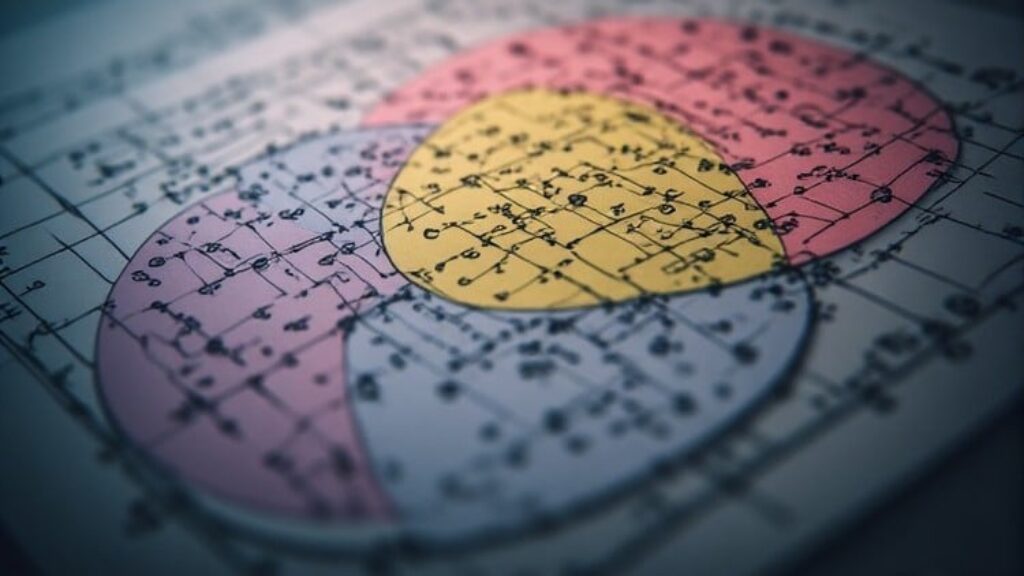
represent union and intersection of two sets, universal sets, complement of a set, difference between two sets by Venn Diagram; (Set Theory)
-
solve problems based on Venn Diagram; (Set Theory)
-
define RELATION and quote examples of relations; (Relations)
-
find the domain and range of a relation; (Relations)
-
represent relations diagrammatically; (Relations)
-
define different types of relations such as, empty relation, universal relation, identity relation, inverse relation, reflexive relation, symmetric relation, transitive relation, equivalence relation, and solve problems based on them; (Relations)
-
define FUNCTION and give examples of functions; (Functions)
-
find the domain, codomain and range of a function; (Functions)
-
define the different types of functions such as injective function (one-to-one function), surjective function (onto function), bijective function, give examples of each kind of function, and solve problems based on them; (Functions)
-
define and give examples of even and odd functions; (Functions)
-
figure out if any given function is even, odd, or neither from graphs as well as equations; (Functions)
-
define composition of two functions; (Functions)
-
find the composition of functions; (Functions)
-
define the inverse of a function; (Functions)
-
find the inverse of any given function; (Functions)
-
find the domain and range of the inverse function; (Functions)
-
define The Principle of DISCRETE MATHEMATICAL INDUCTION and use it for Proving Mathematical Statements; (Mathematical Induction)
-
Mathematical Induction for “Proving the Sum of an Arithmetic Progression”; (Mathematical Induction)
-
Mathematical Induction for “Proving the Sum of squares of first n natural numbers”; (Mathematical Induction)
-
Mathematical Induction in “Proving the Divisibility”; (Mathematical Induction)
-
Mathematical Induction in “Proving the Inequality”; (Mathematical Induction)
-
Mathematical Induction for “Proving the Sum of a Geometric Progression”; (Mathematical Induction)
-
Mathematical Induction in a “Brain Teasing Real World Problem”; (Mathematical Induction)
-
Mathematical Induction for “Proving a result from Geometry”; (Mathematical Induction)
-
Mathematical Induction in “The Towers of Hanoi”; (Mathematical Induction) and
-
Learn to use Mathematical Induction to do Computer Program/Algorithm Correctness proofs. (Mathematical Induction)
We recommend this Discrete Math course to everyone who is a Math or a Computer Science student, or any Working Professional in the field of Computer Science, Data Science, Artificial Intelligence (AI), Computer Programming and Algorithms, Quantum Computing, or any other area which involves programming, data analysis, computer security and digital networks.