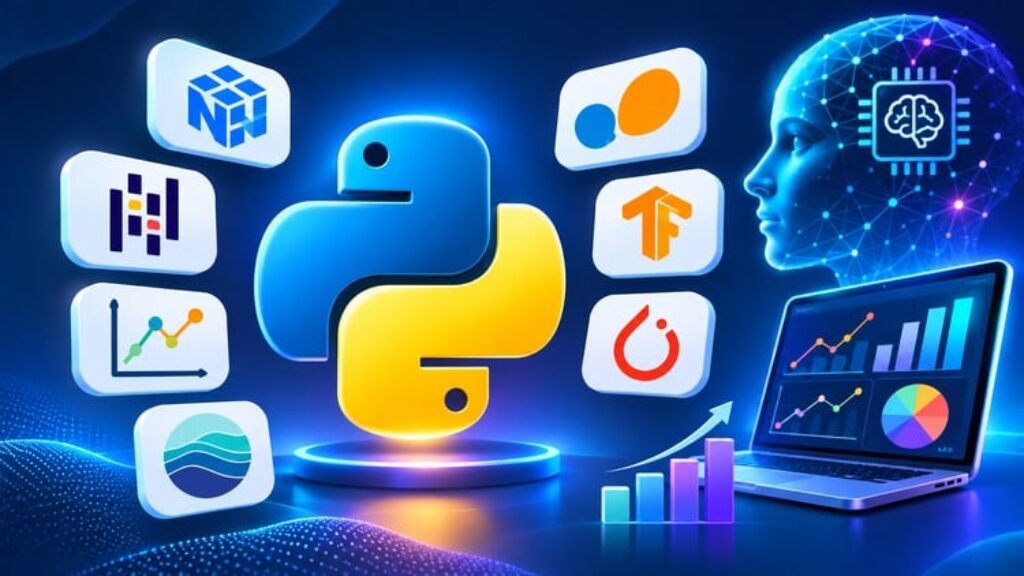
Advanced Python – Master NumPy, Pandas, Matplotlib, Data Science, AI & Machine Learning
Take your Python programming skills to the next level and explore the exciting world of Data Science, Data Analytics, Artificial Intelligence, and Machine Learning!
Have you learned Python fundamentals and are now wondering what comes next?
Are you interested in working with real-world datasets, creating interactive visualizations, performing data analysis, and building intelligent applications using Python?
Then this course is for you!
Welcome to Advanced Python, a comprehensive, practical, and career-focused course designed to help you transition from basic Python programming to advanced Python technologies and the foundations of AI and Machine Learning.
Python is not just a programming language. It is one of the most powerful technologies used in modern software development, automation, Data Science, Artificial Intelligence, and Machine Learning.
In this course, you will explore powerful Python libraries, work with real-world data, understand data visualization, and build a strong foundation for your journey into AI and ML.
What Will You Learn?
Throughout this course, we will cover important Python libraries, concepts, and frameworks, including:
1. NumPy – Numerical Computing with Python
-
Introduction to NumPy
-
Creating NumPy arrays
-
Array indexing and slicing
-
Array operations and mathematical functions
-
Reshaping and manipulating arrays
-
Working with multidimensional arrays
-
Broadcasting and statistical operations
2. Pandas – Data Analysis and Manipulation
-
Introduction to Pandas
-
Series and DataFrames
-
Creating and accessing DataFrames
-
Reading and writing CSV and Excel files
-
Data selection and filtering
-
Handling missing values
-
Sorting and grouping data
-
Data cleaning and manipulation
-
Real-world data analysis examples
3. Matplotlib – Data Visualization
-
Introduction to Data Visualization
-
Creating line charts
-
Bar charts and pie charts
-
Histograms and scatter plots
-
Customizing charts
-
Working with labels, titles, and legends
-
Visualizing real-world datasets
4. Seaborn – Statistical Data Visualization
-
Introduction to Seaborn
-
Statistical visualizations
-
Distribution plots
-
Heatmaps
-
Pair plots
-
Correlation analysis
-
Creating meaningful visualizations
5. Advanced Python Concepts
-
Working with external Python libraries
-
Virtual environments and package management
-
Working with APIs
-
JSON data handling
-
Advanced file handling
-
Practical Python programming techniques
6. Introduction to Data Science
-
What is Data Science?
-
Understanding datasets
-
Data preprocessing
-
Exploratory Data Analysis (EDA)
-
Data cleaning and preparation
-
Understanding real-world data
7. Introduction to Artificial Intelligence and Machine Learning
-
Understanding Artificial Intelligence
-
What is Machine Learning?
-
Types of Machine Learning
-
Introduction to Scikit-learn
-
Understanding training and testing datasets
-
Introduction to machine learning algorithms
-
Building your first machine learning models
8. Introduction to Modern AI and ML Frameworks
-
Introduction to TensorFlow
-
Introduction to PyTorch
-
Understanding deep learning fundamentals
-
Exploring modern AI technologies
-
Understanding how Python powers AI applications
Additional libraries, frameworks, and practical projects will be introduced as the course progresses.
Who Should Take This Course?
This course is ideal for:
-
Students who have completed Python fundamentals.
-
Freshers preparing for software development careers.
-
Software developers who want to upgrade their Python skills.
-
Beginners interested in Data Science and Data Analytics.
-
Aspiring Artificial Intelligence and Machine Learning engineers.
-
Professionals who want to explore modern Python technologies.
Why Should You Enroll?
-
Learn through practical coding examples.
-
Understand concepts with simple and easy explanations.
-
Work with industry-relevant Python libraries.
-
Explore real-world datasets and practical use cases.
-
Develop a strong foundation for Data Science and AI/ML.
-
Learn step by step, from advanced Python concepts to modern frameworks.
Your Learning Journey Starts Here!
Whether your goal is to become a Python Developer, Data Analyst, Data Scientist, or AI/ML Engineer, strengthening your Python knowledge is an important step toward achieving it.
Don’t just learn Python syntax. Learn how Python is used to solve real-world problems, analyze data, visualize information, and build intelligent applications.
Enroll today and take the next step in your Python programming journey!
Let’s learn, practice, build, and grow together!