This course contains the use of artificial intelligence.
Most AI demos look impressive for five minutes. A chatbot answers a question, calls a tool, and everyone applauds. But what happens when a real business process needs ten steps, two different systems, a human approval, and the ability to recover when something fails?
That’s where LangGraph comes in.
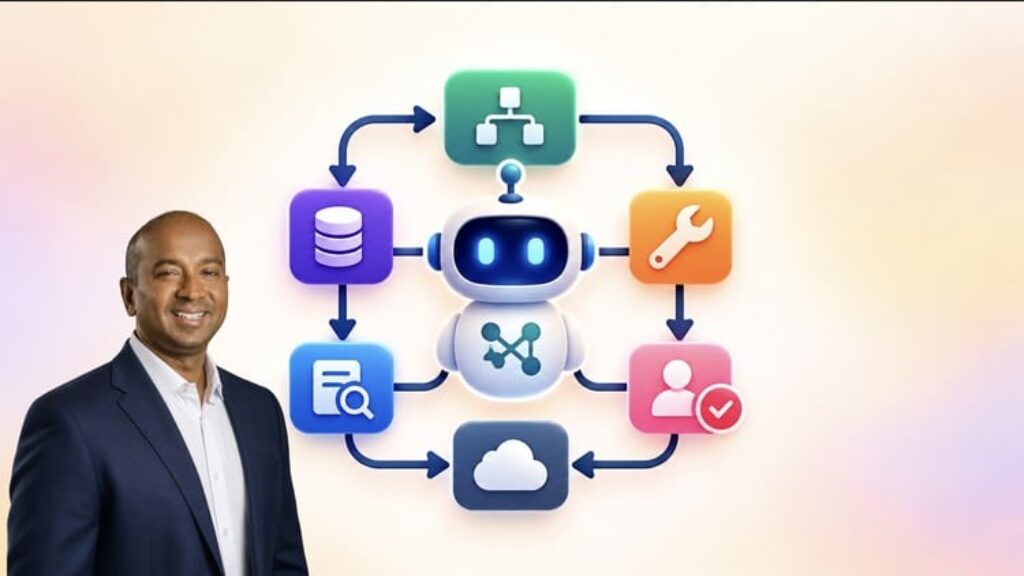
In Building AI Agents with LangGraph and Agent Frameworks, you’ll learn how to design AI applications that do more than generate responses. You’ll build stateful agents that follow workflows, make routing decisions, call tools, retain context, collaborate with other agents, and keep people in control of important actions.
We’ll start with the foundations: how LangGraph represents workflows using nodes, edges, and shared state. Then you’ll create conditional paths, loops, and multi-step processes using Python. You’ll connect language models through LangChain and Ollama, giving you a practical way to complete the core exercises without paying for an AI API subscription.
Instead of jumping between unrelated examples, we’ll build one project throughout the course: BrightDesk, a fictional enterprise customer support platform. It begins as a simple ticket router and gradually becomes a multi-agent system with specialized support, billing, and knowledge agents.
As BrightDesk grows, you’ll learn to integrate REST APIs, custom tools, databases, and retrieval-augmented generation (RAG). You’ll implement conversation memory, persistent checkpoints, and workflow recovery so your agents can handle more than a single request at a time. You’ll also create human-in-the-loop approval steps for sensitive actions, such as refunds or account changes.
Of course, building an agent is only half the challenge. Making it reliable is where the real engineering begins. We’ll explore testing, evaluation, structured logging, monitoring, error handling, retries, security guardrails, and permission controls. You’ll see why a clever agent with unrestricted access to production systems is less of a breakthrough and more of a very enthusiastic incident report.
We’ll also step outside LangGraph. Through practical comparisons with CrewAI, Microsoft Agent Framework, LlamaIndex Workflows, and other approaches, you’ll learn how to evaluate frameworks based on state management, developer experience, orchestration, integrations, and deployment needs. The goal isn’t to memorize a framework’s syntax. It’s to understand the architectural choices behind real agent systems.
By the end, you’ll package your BrightDesk application behind a FastAPI interface, explore containerization with Docker, and assemble the pieces into a deployable, production-oriented project.
Follow a structured path from your first graph to a final architecture, inspecting state, troubleshooting failures, and explaining design decisions clearly along the way.
This course is designed for Python developers, AI engineers, software engineers, solution architects, forward deployed engineers, and technical professionals who want hands-on experience with agentic AI. Basic Python knowledge will help; previous LangGraph experience isn’t required.
Expect demonstrations, guided labs, design decisions, debugging, and occasional moments when an agent confidently takes the scenic route to the wrong answer. That’s part of the learning process.
You’ll finish with practical skills, a working capstone, and a clearer understanding of when to use an agent, when to use a simpler workflow, and how to build systems that people can actually trust.