Artificial intelligence is changing cybersecurity faster than traditional security practices can adapt. Organizations are integrating AI models, intelligent agents, generative AI applications, automated workflows, and machine learning systems into critical business operations. But every new capability introduces security challenges: sensitive data can be exposed, models can be manipulated, integrations can be exploited, and automated decisions can create risks that traditional security controls were never designed to address.
Securing AI is no longer just an extension of traditional cybersecurity. It is an increasingly important discipline of its own. Security professionals must understand how AI systems work, where their vulnerabilities emerge, how attackers exploit weaknesses, and which technical controls can reduce exposure without sacrificing operational effectiveness.
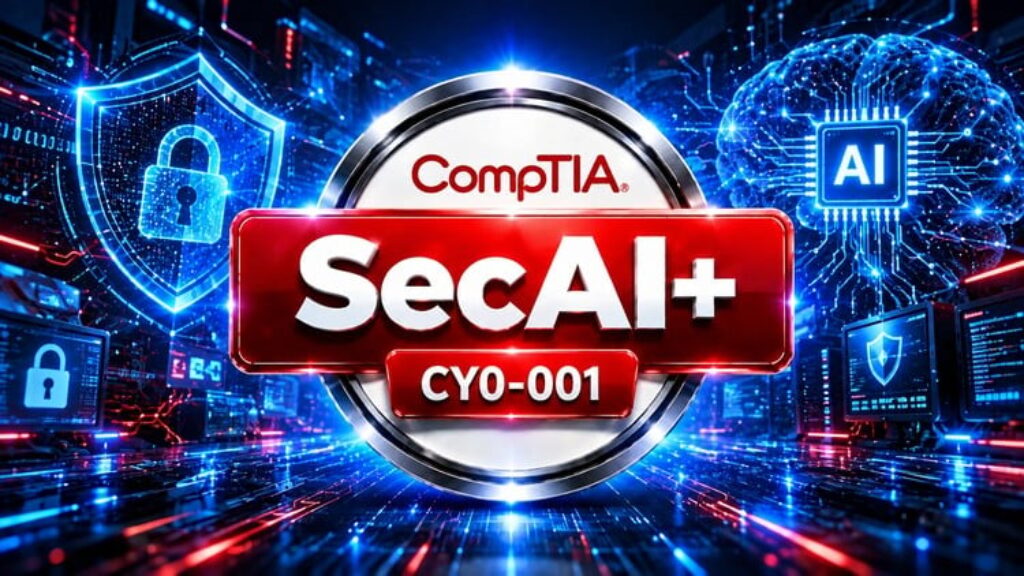
This is where CompTIA SecAI+ (CY0-001) becomes particularly valuable. The certification focuses on the intersection of artificial intelligence and cybersecurity, including AI fundamentals, the protection of AI systems, AI-assisted security operations, and the governance, risk, and compliance considerations surrounding enterprise AI adoption.
Understanding these topics requires more than memorizing AI terminology. Professionals need to evaluate security scenarios, recognize attack patterns, assess defensive controls, understand data protection requirements, and determine how AI technologies should be deployed, monitored, and governed in real organizational environments.
This practice test is designed to help you systematically develop and evaluate that knowledge through 1,500 certification-style questions organized into six focused sections.
Whether you are preparing for the CompTIA SecAI+ certification, expanding your cybersecurity expertise, or developing a stronger understanding of AI security, this course provides a structured way to review essential concepts, explore technical challenges, and identify areas that require additional study.
The course covers AI architectures, machine learning, prompt injection, adversarial attacks, model security, identity and access controls, data protection, threat detection, incident response, AI lifecycle assurance, governance, risk management, and regulatory compliance.
The objective is not simply to understand what artificial intelligence can do. It is to understand how AI systems can be attacked, how they can be protected, how AI can strengthen security operations, and how organizations can manage the risks associated with AI adoption.
The practice test contains 1,500 questions divided into six sections of 250 questions each, providing a broad and organized review of the technical and operational subjects relevant to AI security.
The first section, AI Intelligence Foundations, Model Architectures & Cybersecurity Data, establishes the technical foundation for understanding AI security. Questions cover machine learning, deep learning, generative AI, transformers, large language models, supervised and unsupervised learning, reinforcement learning, fine-tuning, prompt engineering, data integrity, data provenance, embeddings, and retrieval-augmented generation (RAG). You will examine how AI models process information, how training and inference differ, and why data quality, authenticity, and lifecycle decisions influence the security and reliability of intelligent systems.
The second section, AI Attack Surfaces, Adversarial Threats & Model Defense Engineering, focuses on the techniques and vulnerabilities that can be exploited to compromise AI systems. Questions cover prompt injection, jailbreaking, adversarial inputs, data poisoning, model extraction, inference attacks, sensitive data exposure, AI supply chain risks, and insecure integrations. You will evaluate how attackers may manipulate model behavior, exploit external data sources, abuse application interfaces, and target weaknesses across AI pipelines. The focus is on recognizing attack patterns, understanding their potential impact, and selecting appropriate defensive measures.
The third section, AI Security Architecture, Identity Boundaries & Data Protection Controls, examines the technical safeguards required to protect AI applications, models, data, and connected services. Questions cover identity and access management, least privilege, model permissions, agent access, API security, network boundaries, encryption, secrets management, data classification, data masking, anonymization, and secure integrations. You will evaluate how access restrictions, gateway controls, secure configurations, and defense-in-depth principles help prevent unauthorized access and reduce the exposure of sensitive information across enterprise AI environments.
The fourth section, AI-Augmented Threat Detection, Security Analytics & Incident Response, explores how AI can support defensive cybersecurity operations. Questions cover anomaly detection, behavioral analysis, security telemetry, threat intelligence, alert correlation, automated investigation, incident triage, and response workflows. You will assess how AI-generated findings can support security analysts, how suspicious activity can be prioritized, and why automated recommendations must be evaluated carefully. Scenarios also examine false positives, false negatives, model drift, hallucinations, and the importance of human validation when AI contributes to security decisions.
The fifth section, AI Lifecycle Assurance, Security Validation & Continuous Monitoring, focuses on maintaining security throughout the development and operational lifecycle of AI systems. Questions cover data collection, model selection, security evaluation, validation, deployment safeguards, monitoring, maintenance, feedback, regression testing, code scanning, software composition analysis, and automated rollback. You will examine how security requirements should influence AI development and deployment, how changes can introduce new vulnerabilities, and how continuous testing and monitoring help organizations maintain reliable and defensible AI environments over time.
The sixth section, AI Governance, Risk Intelligence, Regulatory Compliance & Responsible Security, examines the organizational responsibilities associated with deploying and managing AI safely. Questions cover AI governance structures, policies and procedures, risk assessment, responsible AI principles, privacy, transparency, explainability, accountability, third-party risks, regulatory requirements, and data sovereignty. You will evaluate how organizations establish oversight, define responsibilities, assess potential harm, manage sensitive information, and align AI systems with internal policies and applicable compliance requirements. The section also explores the relationship between security controls, business objectives, and responsible AI adoption.
Each question includes multiple answer choices, the correct answer, and a detailed explanation designed to clarify the underlying concept. Rather than simply identifying the correct option, the explanations help you understand why a particular answer is appropriate, which technical principle applies, and why alternative approaches may be less suitable for the scenario.
The questions assess knowledge through a combination of conceptual topics and practical security situations. Some focus on AI terminology, model architectures, data processing, and security frameworks, while others require you to evaluate threats, compare technical controls, analyze operational risks, or determine the most appropriate response to a defined problem.
Across all 1,500 questions, you will encounter topics including generative AI, machine learning, transformers, LLMs, SLMs, model training, prompt engineering, RAG, data provenance, AI threat modeling, prompt injection, adversarial attacks, model theft, security guardrails, API controls, identity management, encryption, data protection, AI-assisted threat detection, incident response, lifecycle security, governance, and compliance.
All six sections can be retaken as many times as needed, allowing you to revisit difficult questions, review explanations, identify knowledge gaps, and reinforce important concepts. Repeated practice can help you recognize recurring security principles, distinguish between similar attack techniques, and become more deliberate when evaluating alternative defensive approaches.
This practice test is designed for CompTIA SecAI+ CY0-001 certification candidates, cybersecurity professionals, security analysts, security engineers, AI and machine learning practitioners, cloud security professionals, application security specialists, and IT professionals who want to strengthen their understanding of AI-related security challenges.
It can also be useful for professionals involved in security operations, threat detection, vulnerability assessment, AI development, data protection, technology risk management, security architecture, and AI governance who need to understand how artificial intelligence changes the modern security landscape.
Completing all six sections will give you the opportunity to evaluate your knowledge across a broad range of AI security topics, from the fundamentals of intelligent systems to advanced defensive considerations, operational security applications, and organizational risk management.
The questions encourage a practical approach to security analysis: identify the system and its requirements, recognize the relevant threat, determine which vulnerability or control is involved, evaluate the available options, and select an appropriate security response.
The goal is not simply to memorize individual definitions. It is to develop a stronger understanding of how AI technologies, cybersecurity controls, operational processes, and governance requirements interact, and how those interactions influence security decisions in enterprise environments.
Whether you are beginning your preparation for CompTIA SecAI+, expanding your knowledge beyond traditional cybersecurity, or exploring the security implications of modern AI technologies, this practice test provides 1,500 questions across six structured sections to help you review essential concepts and assess your readiness.
With extensive coverage of AI foundations, adversarial threats, AI system protection, security operations, lifecycle assurance, governance, risk, and compliance, this course offers a structured approach to studying one of the most important emerging areas of cybersecurity.
Build your AI security knowledge, challenge your understanding, identify your weak areas, and prepare to approach AI-related cybersecurity problems with greater confidence and technical precision.